Wednesday, December 1, 2010

Re-igniting the Muse

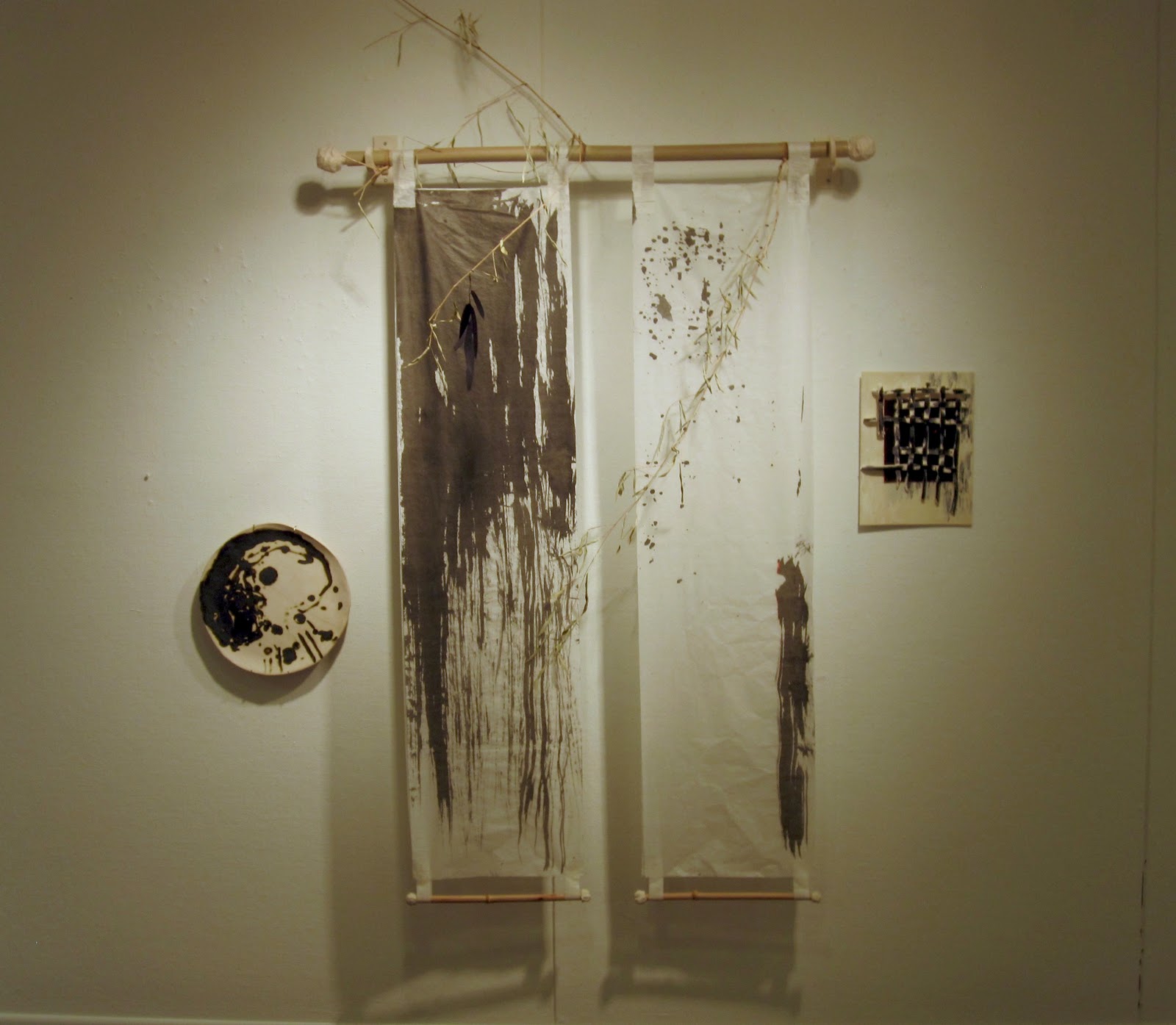
"DARK WATERFALL", ©Joy Kreves '10, mixed media installation.
After exhibitions, after family crises and celebrations, after visits from long-missed family and friends, after making exciting connections, after the hubbub of holidays, where now, oh where exactly IS my muse, my fire?  

This week I got my hands back into clay for the first time since perhaps last May.  Ideas were merely mild and circling, cooking but not reaching even a simmer yet.  I'm eager for my muse to come flying full force back.  I am "ASKING FOR THE FIRE", as ceramist Linda Vonderschmidt-LaStella so brilliantly titled our 2009 ceramic exhibition. I'm not insecure that my muse will awaken.  It will, and I am ready for the fire of it.  

My work could go in many directions from where I left off.  I'd like to make more waterfalls after the two I did for my TRANSLATING NATURE exhibition this October.
Waterfall section from "SOLASTALGIA",©Joy Kreves '10

I'm still excited about finding my own ways to reflect the imagery our earth provides.  My recent "Solastalgia" installation was inspired by our endangered rivers, specifically our Delaware river.  I'm also starting to work with some ideas about coral.  As far as concepts, I want to work with the term "eutierria", another word which, like "solastalgia" and "soliphilia", was recently coined by Prof. Glenn Albrecht as he builds the language with which we can express our relationship with our environment.  He defines "eutierria" as "a positive feeling of oneness with the earth and its life forces".
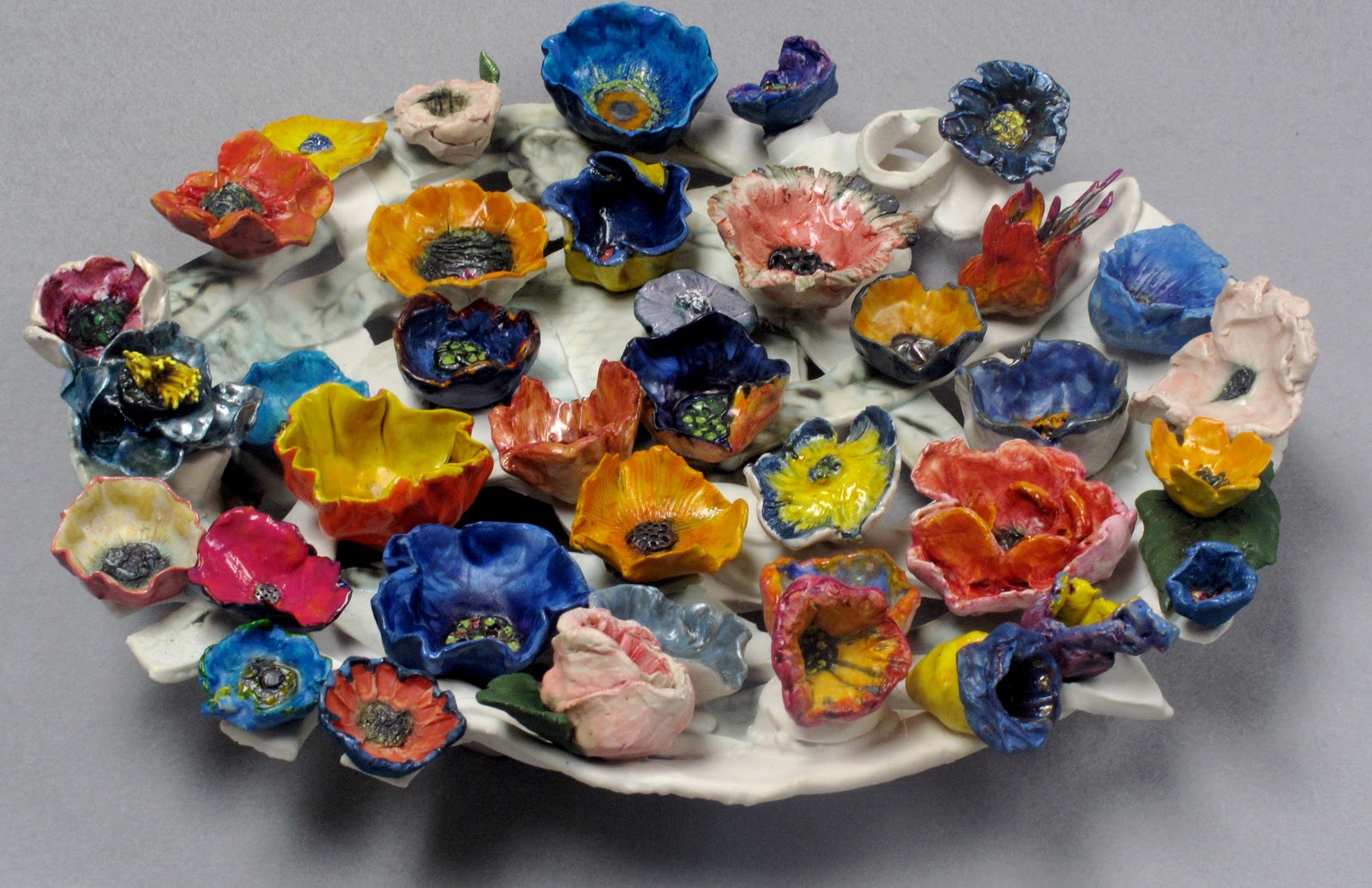
"SPRING EXUBERANCE", ©Joy Kreves '10, porcelain
My "SLICES OF NATURE" and "RIVER" sculpture have many ideas which could be expanded upon like the mixing of a drawing and poetry with ceramic and mixed media elements:
"SLICES OF NATURE", ©Joy Kreves "10


"RIVER", ©Joy Kreves '10, mixed media sculpture w. original poem.
 After a fall full of all the life business that could possibly take an artist away from creating, I'm getting my ankles wet again in the big, creative ocean.  Ahhhhhh...
 

Wednesday, October 13, 2010

Bamboozled by the Storyteller

I was introduced to the character of Scheherazade, perhaps the most famous storyteller of all time, by way of music.  As a preface to her playing of Rimsy-Korsakov's gloriousScheherazademusic on our piano, my mother told me about this woman whose life depended upon her storytelling skills.  Scheherazade's motivation for telling stories had the compelling aura of exoticism that seemed lacking in the flat, bland Midwest where I was growing up. Thankfully, I knew little then about mental or physical abuse. I had not yet met anyone deformed by fear and rage. The very real stories of queens beheaded for not producing male heirs felt like fiction to me.  Therefore, Scheherazade's king, a character so enraged by one betrayal that as a prevention he ordered the murders of his own virgin brides after the wedding night, was far-fetched fantasy to me then.  

Despite King Sharyar's bad record, Scheherazade was confident in her ability to create tales that would literally save her life.  She did this in a storytelling marathon of one thousand and one nights before the king pardoned her.  It occurs to the adult me, that THIS is the kind of storyteller our human culture needs now - someone who can stop our current destructive behaviors by creating stories compelling enough to stop us in our tracks, re-arrange our priorities, and set us on a sustainable path of respect for each other and our entirely living planet. 
below:  Springtime In The Bamboo Garden ©Joy Kreves 2005
 Origins of words, the storyteller's tools, are often very interesting to me.   The word "bamboozled" implies the comedic attitude of slapstick, but it apparently derives from the word "bamboo", because one can get so lost, so disoriented in a bamboo forest.  I have tasted the terror of being lost in the maze at Cawdor Castle in Scotland at about 15 minutes before the 5pm grounds closing time, so the idea of finding oneself lost in a bamboo forest, or a midwestern cornfield, for that matter, holds no humor for me.  You can innocently wander into such a maze and a few steps later find yourself completely disoriented, lost, and trapped.  Scheherazade's husband had his plot all drawn out and she was written in to be just another victim in his story.  If it weren't for her supreme achievement of bamboozling him she wouldn't be a famous character today.  Neither she nor her story would have been projected into her future.  Her future, which is now our present, is where she and her tale exist.  Humans all over the earth have been bamboozled by the stories of our society's military-industrial complex, of our corporations, and of our religions.  We have been consciously and cleverly told that we our very purpose as humans is to dominate the landscape and be a voracious consumer!  The Story of Stuff couldn't put it more clearly.  We've been bamboozled.


The tale that tramples all life on earth includes a new chapter in which the United States Supreme Court concluded that a corporation has equal rights to an individual.  That is but one example of a tale that must be rewritten to recognize the difference between life forms and manmade economic structures.  Our new story will have the following premise:  we are living beings existing on a living planet and we cannot exist on a non-living structure.  Now my father was always telling us as we grew up, "You make your bed, then you must lie in it".  Now I can ask, "Why?  Why must we lie in the wrong bed once we realize a mistake has been made?"  I have to believe we can change our circumstances when we find ourselves in need of something better.

Last week, I was privileged to have the opportunity to hear Miriam MacGillis, the founder of Genesis Farm in Blairstown, NJ. speak to some students.  Miriam, a former artist, a Dominican nun and farmer, spoke of our desperate need for a new cultural story about our human place in the earth's life.  She urges us all to work hard to create a story that embraces scientific knowledge to achieve a shift of power between life forms, and thus save our lives.  Our old and current Judeo-Christian story, that humans are a God-favored, superior life form to all others on the earth has gotten us onto a path of gross destruction.  Let us plant our new deciduous forests with clear landmarks along paths of life-sustaining stories.  Let us recycle those old bamboo forests in order to disorient the old storytellers and their enraptured audiences while we gain time for our new, life-sustaining stories to take hold.

On a cultural level humans have stories to situate ourselves on planet earth.  For centuries now we have been enthralled by the story that we are God's favorite creation, and all other life forms were made for our disposal.  In our current story the environment exists to be exploited by us, for our pleasure.  It has been a well supplied department store.  Increasingly now those store shelves are showing empty spaces.  Like a raging spouse, our habitual beating up of our environment has left scars which cannot be "fixed" by an apology.  Once we have driven the SUV over the metaphoric flowers neither an individual's nor a corporation's crocodile tears and promises will do the job. Healing (if it is still possible) requires an entirely new and sustainable mindset with an understanding of what the consequences of our actions really are.  Life is fragile. 
below:  Fragile Life ©Joy Kreves 2006


We humans have disrupted weather patterns.  Our activities are melting glaciers.  Our mining of resources has stripped huge areas of beautiful ecosystems, leaving nothing but bare, dead swathes of earth where nothing can live.  These are the facts.  I am part of this culture, and I don't know what to do.  I am an artist, and I have to fit my art into this backstory or fit this backstory into my artwork because it is so relevant.  Being an artist is a responsibility and I'd like my art to do more than add more material stuff to our already overstuffed planet. So far the only way I can figure out how to be a constructive part of the new story is by letting myself be a filter for all of these ideas and trusting that something worthwhile will come out in my work.  

We all need tools to work with.  It is interesting to learn that the English language is sadly lacking in the very vocabulary with which to describe our human relationships with our environmental home.  How can a storyteller create without the language?  Trans-disciplinary philosopher Glenn Albrecht  has been working to correct that lack by creating words that are quickly catching on.  One of them, "Solastalgia", inspired my new art installation about my relationship with the endangered Delaware River.  
below:  Solastalgia, ©Joy Kreves 2010


I am a firm believer in the concept of micro/macro.  As things go on a micro level of existence, so do they go when looked at through a macro lens, and all the levels in between. The Arabian Nights is a success story, not only because it was supremely entertaining but because it saved Scheherazade's life.  As resources disappear and climate changes create havoc, many people are beginning to realize that our earth's life is severely endangered, and that it will take a new story about our human position on earth to literally save our own necks.  Who will be a powerful enough storyteller to create a new story- one that enough humans will embrace as enthusiastically as Sheherazade's King Shahryar, thus saving the lives of us all?  
Events not even a week old can be expertly shaded and re-rendered by a talented storyteller in a way that transforms them into an entirely new version of history. The storyteller can even achieve a complete reversal of power between the various characters.  I have witnessed firsthand the power of an accomplished storyteller to bamboozle someone else into believing that they were the cause of a spectacularly destructive rage.  In this kind of story all of King Shahryar's virgins were at fault for their very potential to deceive.  I have seen BP executives move their lips in apology over that disastrous (and preventable) environmental assault.  I have witnessed it in today's politicians who speak the spin that serves their own purposes at the expense of all the rest of us.  Therefore, I believe it is possible that some person(s) with positive intentions to help us all could harness their most powerful storytelling skills and spin all humans towards a sustainable future.  The earth is already spinning.  Our story has to spin in the truth of that harmony.  What we humans on earth need NOW, is a new, more truth-embracing and life-sustaining story of ourselves, because our current story is an express train to oblivion.  Our living earth stage cannot sustain us as the characters we have been playing since the Judeo-Christian story took hold. As my new wise friend Miriam MacGillis says, "we have to try, for we have no choice."  So - will our new Scheherazade please stand up?  For us all?

Monday, September 13, 2010

Burning to Make Boxes

If I had to choose one art tool I couldn't live without I would have to pick my hot glue gun.  This is the case, even though every time I use it I burn myself.  Waiting for other glues to dry is just agony once you've gotten used to the fast-drying hot glue.  I have to transport my work to the Rider University Art Gallery soon, and my work is mostly fragile, unframed, and three-dimensional.  I don't think I could have made the oversized packaging I've made this week without that glue gun.
There are very few glues that work on styrofoam, and work quickly.  I needed to build cushions into the boxes with styrofoam pieces. Most glues will melt the styrofoam. A touch of hot glue will work.  It even glues the bubblewrap to the styrofoam.
Figuring out how to make packages for my work to protect, add rigidity, stabilize various elements during transport AND be lightweight was a real challenge.  I custom built 4 boxes recently.  


The hanging paper scrolls were a problem.  In order to make the big box a little smaller, I brought the bottom of the twin scrolls up by securing the   
endknobs with wire poked right through the box bottom.  Then I "rolled" the scroll up over a paper towel holder that I first covered with glassine paper for it's neutral ph.  Two cardboard fingers can be lifted up to release the scroll from it's packaging.


The bamboo at the top of the scrolls is tied into the box with wires also, and the porcelain end caps are cushioned with form fitted styrofoam.

Pieces like the porcelain LANDSCAPE LATTICE have boxes like that, and have so far survived a number of moves.  They are stored in the stacked boxes in my storage room.
The glue gun is not without hazard.  Almost every time I use it for a project I burn myself.  I had been lucky for several days, but today I was almost finished with one of the huge boxes, when I burned not just one finger, but some fingers, on both hands! As soon as I felt a finger burning on one hand, my other hand burned, and then a fingernail.  I must have gotten a flying hot glue drip.  It's like having hot candle wax stuck on your hand. After finishing the cardboard strip, the first thing I found to "ice" with was a package of old white chocolate chips in the freezer downstairs.  Then I also found a little cold pack.  Well something about the (cellophane?) packaging on the chocolate chips makes that NOT effective for soothing burns.  I tried to hold one cold thing on my fingernail of my left hand while holding another cold pack on two fingers of my right hand.  And I am impatient.  When I should have sat and waited, I wanted to check and answer emails.  Hard to type with hands like that!  An hour or so of an on and off approach, and the pain was calmed down enough to return to my packaging project.  What oh what would I do without my trusty glue gun?

Wednesday, September 1, 2010

My Mother, My Shadow and Me

One of the hardest parts of creating art is deciding when to stop working on a piece.  When is it finished?  The question also comes up when a piece is damaged.  Do you throw it away, do you try to perform heroics to restore it, or do you compromise and take the hint - see where the solving of that crisis takes the piece?  A professional art restorer is going to disguise the damage and try to get the piece back into it's original "finished" form.  An artist, however, has to consider all the options when it comes to damage on their own work.
If only I could get better at "seeing" what life literally puts in front of my eyes!  A couple of days after one of my artworks fell off the wall,  I visited Dia Beacon in New York, and was very interested to see Andy Warhol's HUGE installation of paintings of a shadow, in 102 variations. 
http://www.diaart.org/exhibitions/introduction/98  I didn't even realize until just now, writing this, that seeing Warhol's shadow was a timely lesson for me: there are hundreds of ways to recreate a shadow. I only needed to decide on one - the bottom corner of my piece was smashed in the area where I had shadows from a white cloth.  I did not consciously realize this connection when I viewed the Warhol shadows, though; the lesson was absorbed completely subconsciously if at all!

(left: the undamaged bottom corner)
My large collage, "Biography of a Moth", had hung securely for months, waiting for it's exhibition in my show at the end of this month. My trusty E6000 glue, that has never failed me before, gave way, and the piece came down on a section of shadows.  I hadn't even heard it fall off the wall, and discovered it the next time I went downstairs into my studio.  It was impossible for me to ignore that the destruction occurred around the time of a particularly vehement argument with my daughter, and that the artwork has something to do with my own relationship with MY mother.  I know this in a way that is beyond reason.  I know this in my gut.  Oh oh, this is the kind of "knowing" that gets people into all kinds of trouble!  One person "knows" that their truth is THE truth even when it conflicts with someone else's truth, and they both "know it in their gut".  Therefore, I allow myself to indulge in my "gut feeling" about this artwork while simultaneously letting my big skeptic balance on my shoulder. 

Another aspect of something meaningful being in my face without me even seeing it was the title of the piece.  I had titled it "Biography of a Moth" a long, long time before I realized that that title is also short for "Biography of a Mother".  Am I going blind?  Really!  How much more obvious does my own creation have to be, for me to "get it"?  Duh!


(left: same corner, "repaired".)
I felt confident from the beginning of my damage survey that this smashed corner was something I could deal with, and that the artwork was no lost cause.  My decision was whether to entirely disguise the event or to embrace it in the repair.  I decided to add a visible rectangular layer of mat board to the front surface, but to restore with colored pencils the shadow images that had been there originally as a photograph. I guess it was a sort of compromise.  The surface is changed where the repair is, but I retained the content of the area.  In fact, when seen in the entire piece, I like the addition of that subtle geometry to the surface there.   I also added more support to the backside of the same corner.  Probably MOST importantly, I (bravely) drilled and screwed right through the front of the artwork, to attach a more secure wood strip to the back for a better hanging solution, and then concealed the screws on the face of the artwork.

A sideview portion of "Biography of a Moth" can be seen on the right side of the announcement card for my show, "Translating Nature".  The show will be at the Rider University Art Gallery, on the 2nd floor of the Bart Luedeke Center, Westminster College of the Arts at Rider University, 2083 Lawrenceville Rd., Lawrenceville, New Jersey, and it opens September 30th, 5-7pm. There is an artist's talk scheduled for October 7th, 7pm. The exhibition runs through October 30th.  My mother, my shadow and myself will all be in some form of attendance.

Saturday, July 24, 2010

"It's Cooler In The Mornings" and Other Annoying Advice

I'm sitting in my comfortably air-conditioned house writing my blog about my life as an artist instead of working in the uncomfortably hot studio on this sweltering day in July.  In fact, it's been a month of sweltering days.  I know this in a way I wouldn't have known it other summers, had they been this hot, because THIS month I rented a friend's non-air-conditioned studio (top photo) while she is away.  I needed some extra space to work on some large projects, and it seemed like a good idea.  It was a good idea in that I did get some crucial things accomplished.  I was able to set up and photograph several pieces against the big, white wall.  I was also able to build several sculpture bases.

 My home studio has daylight fluorescent bulbs, which give off a great light, as you can see in the photo above.  It also has a baseboard heater running the length of the longest wall, and wood trimmed baseboards on the others.  The baseboards became a big issue when I tried to get clean photographs of the art.  Also, my home studio only has a 7' dropped ceiling, which also detracts from the taller work.  Some of my new pieces are so tall I couldn't avoid getting those ceiling tiles in the photos.  Ugh.  At this point, I do not have Photoshop and have been editing everything with iPhoto.  I was able to use my vacationing friend's excellent selection of power tools to cut plywood, and use her tabletop sawhorses to glue and nail the sculpture pedestals together. I didn't have to worry about the screaming saw terrifying my noise-sensitive dog into sitting on my feet, either.  It is very difficult to accomplish tasks if a dog is trying to sit on your feet.  Any fantasies I'd had about bringing him to that studio were quickly quelled when I realized how miserable we'd both be there together.

I hate it when people say, which they did, "it's cooler in the mornings, so if you get up and go in early you'll be better off".  Of COURSE it's cooler in the mornings, but I stay up late, often past midnight, doing the computer work and writing part of being an artist, and I'm not like my Uncle Ray, who only needed 3 hours of sleep per night thus living the equivalent of two normal people's lives.  I have a family to be part of and we try to approximate our schedules so we see something of each other.  So.  I'd get up at around 8:00, shower because I must, though it makes no sense when I'm going into a steam bath, check my emails to make sure there were no time-sensitive issues to deal with, eat breakfast so I wouldn't have to stop working and take a break until a little snack lunch I'd bring, perhaps put a load of laundry in, pack the car with that day's project materials, and inevitably finish the 1/2 hour drive to the studio around 10 or 11am.  Then I'd park my car in the glaring sun and proceed to drag my supplies to the studio building, through another artist's studio, and into mine.  Back to the car, and a repeat or two.

By the time I set up the fans and got to work I'd be dripping.  One day I realized I should have sweatbands for my head because I was literally dripping onto my work.  If I didn't have deadlines I wouldn't have been able to get myself to go in there and do the projects.  Even so, I wasn't able to get myself in there many times for two days in a row.  I seem to need an entire day to recover from such heat immersion.  Luckily, there were things I needed to do in my home studio, too, so I could remain productive with an excuse.  My home studio isn't directly air conditioned, but some of the house a/c sinks downstairs.

Other people suggested that I go in the evenings, "when it cools down".  Unfortunately, I am not an evening person when it comes to physical work.  Working at night would also put me into the visiting times for the nocturnal creatures who clearly visit.  Not that the mice didn't visit during the day, but I know they are even more lively at night.  After the landlord sprayed some rodent deterrent into the ceiling, the daytime screeching from raccoons or rats or squirrels partying up there temporarily stopped.  

I know there are lots of people who have to work outside in searing weather:  road construction crews, farmers (okay, I know they DO get up early), and roofers, to mention a few.  I've thought about the slaves who had to pick cotton in the mean sun for hours every day, with no fans.  I realize that I am soft.  I've had it easy.  I haven't suffered from the heat like this since I was a child.  Then, my father used to hang wet sheets in front of the windows, and blow a fan through them, claiming he could feel a difference.  I never thought it helped.  In fact, it seems that would have only added to the humidity, thus making the air even muggier! There are no effective home remedies for being overheated except, perhaps, wrapping oneself with iced towels.  I didn't try that since it would have added to the dripping that was already going on.

These days anyone who reads or listens to the news at all hears lots of talk about climate change and global warming.  Yet it is mostly all talk and no action.  My oasis of cool air may soon be only a memory as we run out of natural resources that power it.  This is happening quickly.  This summer I have some choice on whether to be inside where it is comfortable or inside where it is hellish.  According to some scientists who study all of this, this choice may disappear in my lifetime.  Humans are poisoning and over-fishing, over-farming, over-drilling, over-building, and over-populating our planet, and we may be bringing forth our own demise.  Arriving to work in the mornings or in the evenings when it is cooler, will not solve that.

My month-long studio rental is almost over, and what I've accomplished there in addition to the few projects I already mentioned is a renewed appreciation for the comforts I have at home.  I'm not taking my a/c, my food, my water, or my air for-granted.  I'm not taking our earth for-granted.  And, certainly, I'm not taking my being able to make art in the midst of serious environmental collapse for-granted.  Making art is a luxury that I hope to enjoy for many years yet. I can do it if I'm comfortable enough.
                                                                                                                                                                                                                                                                                      

Wednesday, June 30, 2010

Lackluster Smoking

The last post I wrote was about my participation in "smoking" unglazed ceramic pieces to gain tonal variations without color. When I arrived at the ceramics studio to pick up my smoked tile some of the pieces by other people had already been collected.  Here is a photograph of the small collection that  was left for me to see:

I was rather disappointed in the results.  The smoke color did not play up the textures on the clay or in any way enhance the forms.  Everything looked pretty much just dirty.  Previously, I had painted some high fired tiles with watercolor, and the watercolor sank nicely into the recesses and rolled off the relief surfaces, enhancing what I had built.  This was not the way the smoke acted.  It indiscriminately singed across the piece in a muddy wash. Truly, I did not spend a long time making my tile.  I had to get something done in time to be ready for the smoke fire, and it's probably not my best work.  I had hoped for a more dramatic effect, however.
 I have seen smoked sculptures that were beautiful. I'm sure there are a few tricks to getting this kind of finish to work for the form, but I don't think anybody was very impressed with our first attempt at this process. I'd pick the watercolor effect any day.


above left: watercolor on porcelain.
below: smoke fired porcelain

Tuesday, June 15, 2010

Benefits of Smoking

My parents were militantly against smoking, and one of the most stressful times in our family was after I reported to them my discovery of my older, teen brother's stash of smoking supplies in a thicket in the back field.

Although I never smoked myself, I breathed in vast quantities of second hand smoke as a waitress in NYC before its restaurant smoking ban. I am currently wondering how my non-smoking daughter will deal with roommates or friends smoking at college should that be an issue during her freshman year. Now, having lived away from city air for a couple of decades, I am full of gratitude for the air that smells of honeysuckle or freshly rained on earth.  The less one is exposed to smoke, the less tolerance one has for it.  Hence my current intolerance for smoke even in forms like incense.  We changed our wood-burning fireplace to gas because the little bit of smoke it produced aggravated my otherwise mild asthma.  Nothing thrills me now like sweet, clean air.

None of this was on my mind when a ceramist colleague invited a bunch of us over to her rural house to do a "smoke firing" last Monday. I've seen the beautiful, delicate, atmospheric patterns that smoke firings can leave on ceramic pots, and was eager to see how it was done.

A pit for the firing was already in place:  a 2 ft. X 4 ft. X maybe 2 ft. deep, dug out dirt hole lined with piled up bricks.  We each draped our previously bisque-fired (low-kiln-fired) but unglazed ceramic works in banana peels, copper wire, bamboo leaves, or whatever we could think of that might leave some organic deposit of hue or pattern on the white clay.  Then we wrapped each collage in newspaper and set it on a bed of sawdust that had been sprinkled into the bottom of the pit.


All the pieces were "loaded" into the pit, and completely buried in sawdust.  Then we laid metal grates across the top of the pit.  It was damp that evening, so the newspaper torches didn't want to light.  It took quite a few starter nuggets planted into the sawdust to finally catch fire.


Once it looked like the fire would continue, we placed ceramic tiles over grates to make a roof, so the pit would only smoulder, and not blaze.  Then we went in to have dinner.

About 45 minutes later we went out to check on our smoking pit, and sure enough, a good stream of smoke was rising up into the treetops, and no flames were leaping out.  All looked as it should.  However, I had to keep away from the direction of the breezes, because I then realized that, "DUH, a smoke firing was going to make smoke that I wouldn't like to breathe"!  As exciting as this was, I wasn't ever going to want to do it myself, since that would entail being in the midst of the smoke at least when getting the pit started.

 In a couple of days we will all get our smoke-fired pieces back from the pit, and everyone is looking forward to seeing what happened in there.  Did any of the organic matter affect the results?  I only had one tile to contribute, but am really curious about how it will look. 

I am glad I wasn't the one doing the most attempted lightings, and I hope the benefits of the smoking will be worth it to whoever breathed in the most smoke during the process.   

Followers