Saturday, June 4, 2011

Celebrating Creativity Through the Eyes of a Bug

Wrapped Junebug sculpture
My unveiled 2011 Junebug sculpture, ©Joy Kreves'11
Bugs are getting lots of press lately.  New Jersey, where I live, has a Brown Marmorated Stinkbug problem that has developed in the past several years.  These tough, flying bugs like to come buzzing into our houses.  They have a rank, "green" smell when you smash them.  Yes, I do smash them when I find them in MY house. I've grown used to that smell.  Also, the East Coast is increasingly suddenly suffering with bed bugs.  So far I am counting my lucky stars that these pests haven't found my residence.  May and June are known for the appearance (outside, at least!) of "June bugs".  This bug, though, has become the official mascot of art appreciation in the town of Metuchen, New Jersey, which is having its 4th annual Magical, Mystical Junebug ArtFest on Friday nights in June to celebrate the creativity that brings pleasure and meaning to our lives.  

This event is the brainchild of Metuchen's resident ceramist, Linda Vonderschmidt-LaStella.  Linda is a creative force in town already with her art studio being a hub for clay students of all ages.  I met Linda years ago, when we both belonged to "Cycles", a group of women artists.  A couple of years ago we reconnected to have a show she envisioned at Metuchen's Westerhoff Gallery.  When Linda asked me if I'd be interested in creating this year's Junebug sculpture to preside over the town for the month, I'd just finished having my solo show at Rider University Art Gallery, and was recalibrating.  I'd never made a work of art to stay outside before, and decided to take her up on this challenge. 
JUNE LOVE, ©Joy Kreves 2011
The result is a mostly aluminum sculpture that draws from ideas in my series of artworks utilizing lattice motifs to represent our deep interconnectedness with the natural environment.  The lattice sculptures are as much permeable membranes as they are concrete objects. They influence as well as alter a particular view or a particular viewpoint.  I understand my own outlook as the lattice through which I experience and process whatever life and environment have in store for me.  I find this connectedness endlessly intriguing.
JUNE LOVE, wing detail, ©Joy Kreves'11

My “June Love” sculpture on display in Metuchen this month is a natural extension of the lattice idea. I used metal mesh and perforated sheeting for both practical and conceptual reasons. The open “latticed” metal textures make the sculpture lighter and less susceptible to the wind. June bugs eat leaves, often leaving only a lattice of veins.  They have abdomens and under-wings that are transparent but for the veins.   

I took lots of artistic license with my junebug.  Her antennae became more like arm feelers, and I left off her long legs entirely.  She is much more glamorous with her swarovsky crystal eyes, than the real thing.  Perhaps my June bug will inspire romance; she chewed a heart-shaped hole from her leaf in honor of June brides and true love.  

Having grown up on Edward Lear's BOOK OF NONSENSE, I couldn't resist being inspired by my own bug and also came up with several goofy verses on the theme:

There once was a beetle named JUNE
Who would sit on a tree and just croon
As she dined night & day on green leaves she would say,
"Why can't I just sing a nice tune*?"
*June bugs are not known for making a melodious sound.

There was a small town named METUCHEN
Whose residents sang songs in Russian*
They danced through the night to the June bug's delight,
Those wonderful folks of Metuchen.
* I have no idea whether or not Metuchenites actually sing any songs in Russian.

There was a June bug in Metuchen
Who so loved the leaf she was clutchin’,
She nibbled away in a heart-shaped display
That lovely young bug of Metuchen
June Love detail, ©Joy Kreves'11

There is a schedule of events for the ArtFest including presentations by visual artists Sandy Skoglund and Jane Dickson, musicians and filmmakers. For a complete celebration of creativity, come to Metuchen on a Friday evening this month and reflect on what impact the creativity of musicians, filmmakers, chefs, writers, and visual artists has on your own life, and what that's worth.  My own answer?  Priceless!

Monday, May 16, 2011

Earth Brain

For two weeks I've been working on a new painting.  This one has been a real struggle, the kind that causes one to have frequent thoughts like, "should I just scrap the whole thing and start over?"  or even, "Why did I think I was an artist, anyway?" 
The painting's subject matter is the relationship between the earth and each one of us. As I've worked I've also been turning ideas around in my mind for this post. 

Today, as if to spur me on, I spotted a Pileated Woodpecker drilling on a short tree stump in someone's front yard.  Once nearly extinct, these striking birds have made a comeback.  I'd never seen one before.  I whipped out my handy pocket camera and caught a shot:
Pileated Woodpecker, ©JoyKreves, 2011


What does seeing this bird have to do with my painting?   When I searched "Piliated Woodpecker symbolism" I found this delightful website:  http://www.birdclan.org/woodpecker.html , which lists the bird's attributes as:

-Connection to the earth - That is just what I'm thinking about; the connection of our physical and psychic beings with the earth!
-Ability to find hidden layers - This is exactly the creative process.
-Understands rhythms, cycles and patterns - Clearly, these are necessary artistic skills.
-Warnings - What more important warning could there be than the warning that our earth home is a danger of irreversible damage? This is a theme that runs through my current work.
-Prophecy - Well, I'm honestly not sure yet how this one pertains...
-Associated with thunder - especially pertinent because there have literally been rumbles throughout the week. The storms now are just unnatural in their fury.
-The Earth's drummer - Doesn't every cause NEED a drummer? What better cause to drum for than our earth?
-Pecks away at deception until the truth is revealed - Well, that is just like the process of creating art.  One must simply keep pecking away at the painting or sculpture until its own truth is revealed, and sometimes that turns out to be rather different from what you thought you'd end up with.  If it's good, it rings true.

I wanted to write about the intimate connectedness of our human be-ing and our natural world.  This is what my artwork is about.  I am exploring the question, "What does the natural world have to do with ME?"  I believe that our brains are actually so infused with the landscape that when that landscape becomes degraded we experience suffering. 

Solastalgia, Waterfall Detail, ©Joy Kreves '10
"Solastalgia" is the word for this painful condition, a word coined by trans-disciplinary philosopher Glenn Albrecht, who experiences it first hand as he witnesses the swiftly developing environmental degradation caused by global warming around his home in Perth, Australia.  Naturalist/philosopher, Thomas Berry, was quoted recently in the  NJWild blog:  "Degraded habitat produces degraded humans."  This is the real danger.   
What positive conditions might we humans experience that are directly caused by our deep connection to the earth?  How about another of Albrecht's words, "eutierria", or a sense of existing as part of and in harmony with the earth?

Painting palette for Brain Landscape
Painting-in-progress, "Brain Landscape", photo ©Joy Kreves, 2011
Did you ever marvel at the way the network of nerves in a human body resembles the branches of a finely-limbed tree?  I have. Every level of our physical being seems to have a mirroring aspect in the environment.  Our universe is made up of patterns, colors and forms repeated on both microscopic and macroscopic levels. Artists, whose language this is, have long known that beings and their environments have visual sympathies which reflect a deep organic/psychic union.

I've put aside last week's  troublesome painting and I have embarked upon a new  "Brain Landscape" to more clearly express this idea. The first stage of this work-in-progress is shown in the photo here.  My idea begins with the famous photos of our earth as seen from outer space:  a luminous, watery blue jewel.  I am painting a brain that will have the same luminous water, in rivers and atmosphere. 
To artists and naturalists it is no surprise that a being is intrinsically tied to its environment, and yet those people who deny global warming seem to lack a sense of that connection.  Those who believe the earth and everything on and in it is here for our human disposal are lacking a fundamental understanding of what it is to be human.  Perhaps this is the degradation of humans that Thomas Berry warned about.  We cannot drill for gas, pouring toxic chemicals irreversibly into the earth without devastating results to our precious and limited supply of water.  And we are that water. Our earth has some land, surrounded by vast oceans.  Our bodies contain precious supplies of water throughout.  Here is our problem:  water is a finite resource.  The water that exists is the same water that has existed since the beginning of our earth.  This is an awesome fact.  If we poison it we will not get any more. In poisoning it we poison ourselves, and our beautiful brain landscapes will be degraded into shriveled, water starved environments incapable of supporting the eutierria that we require as healthy individuals. The rivers and oceans that make our life possible cannot come back from the brink of extinction the way the Pileated Woodpecker has.  The earth's landscape can filter out only so many poisons before the toxin load is too great and our ancient water supply is beyond saving.  Every human must nourish their beautiful, luminous earth brain.  Now. 

Thursday, April 14, 2011

Poem for the Trees

All winter I've been driving and walking along Jacob's Creek.  Each time, the barren monotony of winter has been broken by the pale notes of Beech leaves.  Now, at the cusp of season change, I thought I'd better write this appreciation down, and so...

A POEM FOR THE TREES
Don't even try
to imagine winter woods
without the Beeches

Amidst dull masses
of branch, trunk and thicket
their faded copper dreams hover mid-air

Sustained leaf chords
so delicately ornament the space
between the silent sleep of trunks

Don't even try
to think of spring's new greenery
without these forest belles

Waving frozen showers
of pale woodland lace they lead
winter's landscape to next season

Only winter Beeches
whisper to the future
while still embracing recent past

Don't even try
to imagine winter woods
without the Beeches

All photos on this blog are copyright by Joy Kreves and may not be used or reproduced for any reason without permission.

Friday, April 1, 2011

In Search of a Certain Green

Here it is, spring 2011.  My daffodils refuse to open and the forsythia blossoms look positively cowered.  Winter coats that should be getting their end-of-season cleaning are still being worn, with hats and even gloves. It's that time of year when one looks forward to glimpses of the bright, fresh green of new growth.  That's the green I've been in search of  for my current sculpture project, and it's taken me some sleuth work to find it. 
Green stitching detail on metal sculpture
During the winter months I compiled materials for my June bug sculpture that is to be unveiled at Metuchen's Art Fest the first Friday in June.  
Location for future sculpture display
Because I've never made an outdoors sculpture before, I had trouble deciding what materials to use to withstand wind and rain, so I proceeded to begin TWO June bugs:  one mostly ceramic, one mostly aluminum. I made a heavily perforated ceramic body and wings so the wind could whistle through.  Positioning the ceramic wings up and out in flight would be too precarious, though, so if I finish this bug at all, it will have to sit somewhere flat.
Unfinished test of ceramic June bug.

 
At various hardware stores I had also bought a variety of metal mesh and aluminum flashing and aluminum glue, and an assortment of brightly colored polypropylene twine for the metal bodied bug. I was liking the light, airy effect and texture of the metal meshes.
Assorted mesh sculpture materials including some fruit bags...
Bright, fresh green and metals
I had started to attach those parts by sewing them together with colored twine; specifically, polypropylene GREEN twine.  It was one of several colors I'd picked up in the "gathering potential materials" phase of the project.  I'm liking the silver aluminum outlined with that bright, fresh green.  Well I used up the green twine ball 1/2way through the bug outline and went in search of more.  Nobody at the store I thought I'd bought it at recognized it.  The manager of  the 2nd store said, "No we don't have anything like that".  The small local hardware store had never heard of it.  Finally, I tried another big chain hardware store that I'd been to recently, and "VOILA", there was the box of twine...in pink, purple, yellow and blue, but no green.  An internet search at home finally turned up a store that carried the twine and claimed to have just ONE ball of the green, which the clerk promised to save for me at the customer service desk if I got there that evening.  I rushed there just minutes before closing time and sprinted to the customer service desk to request my treasured twine.  "No, there isn't anything here"...finally the clerk was found who had forgotten to bring it there but did go get my precious twine. 

My June bug is to go on a big leaf shape that I cut out of some sheets of perforated aluminum - a material already suggestive of the bug that munches its way through tree leaves.  At some point I thought I'd use some of the other colors of the poly twine to whipstitch the edge of the leaf but no, what I really want is more of that green.  I don't know about other artists, but my decisions are influenced by nature's suggestions.  It's that time of year when fresh green is the tonic needed to cleanse the winter doldrums away. 

Sunday, February 27, 2011

Satan's Socks

Hannah Fink's shoe sculpture, in RAW BEAUTY exhibition, photo©JKreves

Last evening I attended Miriam Mill's directed play, "The Last Days of Judas Iscariot" at Rider University's Yvonne Theater.  David Spadora, the talented actor who played Satan, was costumed brilliantly, in a contemporary, collared white shirt, black jacket, black pants, and red socks. (seen at center of photo, in different clothing if you click on the link above) The socks really did it for Satan.  I don't think he could have been as convincingly dark without them.  The red socks screamed DANGER even when the actor was portraying the "I'm just another ordinary guy" side of Satan's act.  


Somewhere is an old photograph of our family with the cousins from my mother's side.  Although it seems to be lost, I remember it clearly.  We are all gathered on, beneath, and around a metal swingset on a summer day. Everyone is nicely smiling, but as usual my father is goofing. He is wearing bright orange socks, and is lifting his knee and pointing to the socks.  As if they might be missed without the special attention!  I was in high school then, and appreciated my father's socks as a fashion rebellion.  Those attention-grabbing socks were kind of a statement of his unorthodox thinking, and I was pretty sure that most dad's were not wearing anything like them just as most dad's were not thinking anything controversial in those Midwestern summer days.  I never could figure out where he GOT the orange socks, since white or black were the only colors that seemed to be sold.  In those days my dad was using his pulpit at The DuPage Unitarian Universalist Church to preach humanistic sermons about the environment and peace, sermons against the Vietnam war.   Someone upset by those beliefs had written into the local newspaper that it was clear that my father was "the devil", and they could "see it in his eyes" from his picture in the newspaper.  I'll bet if they ever saw him wearing those orange socks they'd have been even more sure of the Satan within him.  Anytime a bright color seeps through banality it hints of revolution, and it gets your attention.

Recently I was fortunate to have viewed "Raw Beauty", a mixed media sculpture exhibition at the Arts Council of Princeton curated by Rebecca Kelly.  The photos in this post are ones I took in that exhibition. One of my favorite sculptures was "Raw Suffering of a Woman", a dress by Lesley Haas incorporating handmade paper flax, shredded strips of New York Times and Women's Wear Daily.
Lesley Haas sculpture, photo ©Jkreves
Although mostly subdued colors, the bits of bright red on the shredded paper skirt suggest that life is still there and the suffering is still going on.

Another remarkable piece in the show was Miriam Schaer's 20 ft.long "No Ornament as Precious as Their Hands", made of Embroidery, beads, gloves and paint. Again, the overall neutral tone of the piece was enlivened by slices of red here and there, and the turquoise beading.
Miriam Schaer sculpture, photo ©Joy Kreves

detail of Miriam Schaer sculpture, photo ©Joy Kreves

Leslie Pontz, "Pregnant", photo © Joy Kreves
 As I write this the people of Libya are in a roiling turbulence trying to rid themselves of their oppressive leadership.  I hope that, like the Egyptians and Tunisians, they will soon feel the brilliant sparks of freedom burst into full bloom.  According to Sheryl Gay Stolberg's reporting in The New York Times, the writings of "a shy intellectual" provided some of the strategy for the Middle East revolutions.  Well-written ideas can be those brilliant colors that make instigating political action possible.


This is not a deep insight, that glimpses of brilliance amidst conformity brings vitality to our lives, but it is something worth noticing, remembering, and appreciating whether in fashion, thinking, politics or visual stimuli.  Such visual stimuli is not simple.  It is based on a gut-level recognition that there is something alive there, stirring or smouldering, something to watch out for, something possibly dangerous.  What color socks do you wear?


Monday, February 7, 2011

Becoming the Bug

On the morning following two days of shoveling a heavy, wet snow, I awoke on my back.  I wanted to turn over, but my arms felt little and weak and sore.  With some struggle, I managed to turn over but I thought, "That must be the way a beetle feels when it's flipped over..."

New Jersey Winter, photo ©Joy Kreves 2011
I've been thinking about beetles lately, because I have a new sculpture project.  I'm making the JUNE BUG sculpture for Metuchen's annual June Bug ArtFest.  Although I embraced this project enthusiastically, I ran into problems immediately.

First and most challenging for me is how to create a sculpture that will sit unharmed by weather, in the sun, wind and rain.  All of my sculptures have been made for indoor environments.  Creating for the outdoors is a whole different ballpark.  My previous mixed media works have been constructed with glue guns and other strong glues, using fiber, paper, balsa wood etc.  Suddenly, "mixed media" seems limited!  I contacted a sculpture supply company about two of their products which sounded promising for outside artworks. I asked if the products would hold up in the weather.   The email response I received suggested that I find somewhere warm and dry to create, because these outdoor conditions present challenges for any material that needs to cure!  How did I miscommunicate my question?  No, I had not intended to create the sculpture outside in this New Jersey winter!

Another problem was the subject matter itself.  Beetles had never captured my interest.  Knowledge breeds interest, though, and I researched June bugs, hoping they were at least the iridescent green ones I've admired as they lay flipped on their backs on the hot summer road.  Unfortunately, June bugs are no beauties.  They are just smooth brown beetles, a basic oval shape with a furry chest area and a somewhat gross-looking semi-transparent body.  Even their babies are on the disgusting side - those white, curled grubs that eat your plant roots.  No cuteness there. They stay underground for three years before making their appearance in May or June as the June Bug we know.  We hear their familiar razzing chorus in the summertime which I find quite pleasant. 

Okay, time for a big dose of artistic license!  MY June bug is going to have some color, some texture, some outsized "eyelashes" (they do have eyelash-like antennae beneath their eyes).  I am going to try to reference their natural transparency somehow though, and emphasize the geometry of their shape.
Blue Mtn. Lattice,©JKreves 2005

Landscape Lattice, ©Joy Kreves 2006
The sculpture base is always the hardest part for me to work out.  In reviewing my previous work I have realized that I most enjoy creating "relief sculptures" more than truly 3-Dimensional ones "in the round".  My entire hanging lattice series fits somewhere between 2 and 3 dimensional work, with some double-sided and some only one-sided pieces, yet they interact with their surrounding space and environment the way all dimensional works do.  As it turns out, I have one extra hanging lattice stand that is looking like a good option for my June Bug sculpture.  It is certainly stable enough for outside, not too heavy for me to manage, and made of steel which will rust in the rain if left unpainted as it is now, but that patina could be nice.

As for possible materials for the bug itself, I've looked at waxed cardstock, (used milk cartons), which I once created surprisingly durable birdhouses from, fiberglass reinforced plastic drop-cloths, wire screening, pellon, and I've made a small test bug from sculpture clay.  A size-able ceramic sculpture would be pretty heavy.  Maybe PART of it could be clay, the rest - metal?  The search continues, but at this point I think it will be mainly different metals with some ceramic parts.  I've already created the outline of a large leaf that my June bug will be clinging to.  As the thinking process moves along I am finding more interest in my subject.

Am I empathetic enough to truly understand my subject matter?  Like method acting, I wonder if method creating would be a helpful way to get in touch with my inner June Bug and thus lead to a stronger sculpture.  I already got a taste of how they feel when my exhausted arms could barely turn myself over in the bed; I've thought about them as I munch my salad leaves; I've spent so much time bundled up in layers and layers to keep warm this winter that I may have come as close as I could to experiencing the compact, inflexible shape the bugs have...perhaps I should reread Kafka's METAMORPHOSIS to  really get in touch with my inner bug.

Monday, January 3, 2011

Red, Irresistible Red


Having just finished the season of Rudolph's nose and holiday bows, I was starting to think about spring bud green and winter river water blue, but red came back for another visit tonight in the form of a female cardinal.  

The brightly billed bird was duller than her flashy male counterpart would be, but she suddenly appeared outside at our window ledge, fluttering up against the glass and pacing back and forth at the window.  She looked curious and excited.  She was a very cute bird, with bright red accents on her beak and hat and wings! 

Red.  No other color screams for attention like it.  Cardinal red, sports car red, fire engine red, lipstick red.  Powerful, visceral, siren-like red.
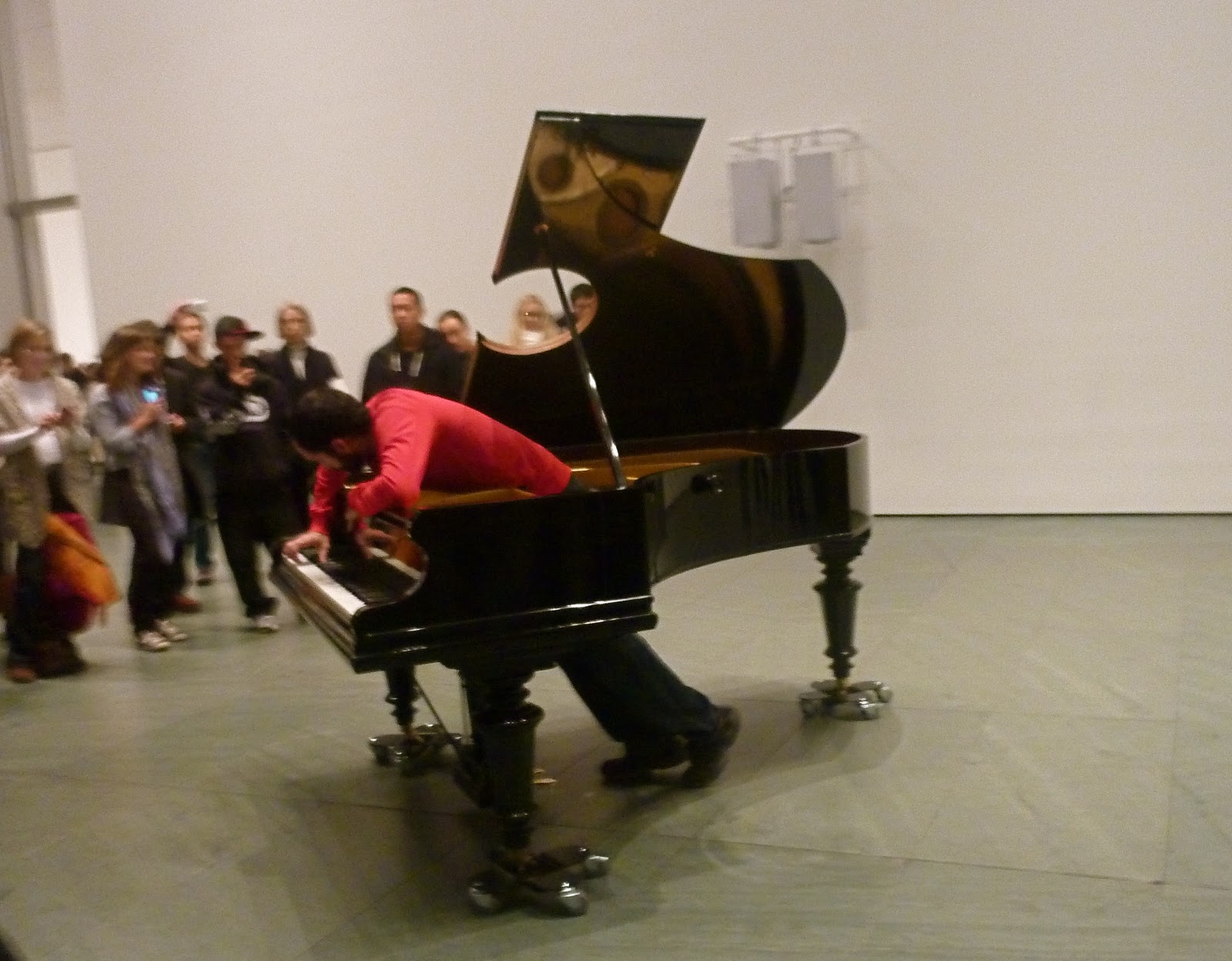
Last month I was at MOMA in NYC, for one of Jennifer Allora and Guillermo Calzadilla's performances, Stop, Repair, Prepare: Variations on Ode to Joy for a Prepared Piano (2008)  How visually satisfying the artist's red shirt was against the black piano!

I've indulged in the color red in many of my artworks.  An early painting titled, "WONDERFUL RED THINGS", was just a catalog of some of my favorite red things such as pomegranates, antheriums, etc. painted all together in one composition.  Done during the pre-digital days, I have only slide records of that painting now, but my fascination with red things remains. Below are a very few of the red-color dominated artworks I have created over the years:

ALINE'S FLOWERS, porcelain, private collection. ©JoyKreves'11


PATRON, Flashe & gold paint on paper ©JoyKreves'11.

Red Chalice, private collection, ©JoyKreves '11

SCHOLAR'S VASE, sculpture, ©JoyKreves '11


TREASURE KEEPER, private collection, ©Joy Kreves '11

The little cardinal was clearly attracted to something and wanted in.  She wasn't attacking her reflection, as some male cardinals do.  She looked and fluttered but would not turn away.  I got my camera out and the flash didn't scare her away.  I turned off the lights.  


She stayed.  For a good 10 minutes she tried and tried to get in.  I thought birds slept at night!  What was keeping her up so late?  I had some plants on a tea cart by that window so I moved them to another room in case she was thinking they looked like an inviting place to spend the night.  She stayed.  Didn't she have a mate to attend to?

I moved the candlesticks away, remembering that crows are attracted to shiny things.  Maybe their silver called to her.  She stayed.  My daughter reached her hand out but the bird skittered away to the far edge of the window ledge.  Guess she wasn't looking for a human friend.  Then I realized that we had a bright red napkin sitting on the dining room table in her sight, the same color as her mate should be, and that I was wearing a bright red sweater.  I changed my clothes to black.  I removed the red napkin.  Finally she turned around and flew away!

It seems it was the red she was attracted to, and which kept her awake in the nighttime when she should have been nestling her head beneath her wing.  Who can blame her for staying awake to try and meet all that big, healthy, attractive red that was calling to her from our house?  I hope she soon finds it or returns to it in the form of another cardinal though.  I'd hate to think my sweater or napkin lured her into loneliness or promiscuity. 


Followers