Relatives of mine have had dogs who "sang" along with them, or their piano playing. The dogs may have just had the instinct to join into a stand-in for a canine chorus. My brother's German shepherd, however, would get started with help, but went onto more solo singing than I'd expect from pure instinctual behavior.
Last night my dog reacted to a photograph, making me wonder if dogs can make sense of two dimensional images. If dogs can make sense of pictures, it follows that they might be able to appreciate art in some way. Perhaps they are even capable of having an aesthetic experience.
I had sat down on the old white sofa to look at a magazine. Because it's the only piece of furniture my dog is allowed to come up on, he happily made his arthritic effort to join me there. I leafed through page after page of creative advertisements as he relaxed beside me, but when I came to the double spread for Bulgari in which a bare model embraces a fragrance bottle while cuddling up to a lion, he lifted his head and strained his nose towards the magazine, sniffing intently. My dog continued his investigation until he satisfied himself that there was no living creature there wearing that fur. Although the ad shows a fragrance bottle, there is no sample of it in the page, so he was not reacting to a smell. He must have reacted to the image of fur or perhaps the lion's features. I tested the theory by continuing to turn pages of photographs and watching him ignore me. I stuck some other pages under his nose, which he simply ignored, but when I stuck the spread with the lion in his face again he sniffed it again, for a shorter time and with less interest than the first time before relaxing again with a sigh, as if saying, "Oh yeah, that's that same nothing I checked out before."
In an article in Cerebrum, from the Dana Foundation, "your gateway to information about the brain and brain research", authors Gisela Kaplan, Ph.D. and Lesley J. Rogers, D. Phil., D.Sc. say,
"Creation and appreciation of art are aspects of consciousness that we have tradition-ally viewed as purely human activities, ones that express our highest cognitive abilities. If animals share at least some aspects of this ability, we will have to look upon them with more respect and perhaps change the ways we treat them."
The authors go on to say that "some researchers have dared to suggest that animals may play because they find it pleasurable to do so. Doing something for pleasure, rather than for survival, is part of how we define the act of creating art." They warn against forming any conclusions too soon, but I'll peak around that corner to see what may lie there. Perhaps my dog has not only the ability to appreciate art, but the ability to create it!
I've been amazed to watch my dog play creative games. He has trained me to throw treats out the window. Usually he runs right to it, settles down on a plush patch of grass, and begins to devour it. Several times, though, although I'd thrown the treat with pretty good aim, landing it near him and certainly within his sight and smell range, I've seen him pretend not to see it. This dog who has smelled a stale oreo cookie 15 ft. away, pretended that he just could not see or smell that fresh treat right under his nose! After a few minutes of exhaustive "searching", he finally "discovered" it, joyfully tossing it in the air. This was pure pretending, pure playing. To create art it is necessary to engage in lots of pretending in order to create illusions of form and space. Having the ability to pretend implies an ability to appreciate creative pretending, does it not?
The magazine lion incident reminded me of a Halloween some years ago. When my daughter was a toddler (before we had our dog) she had a lion costume. We later gave it to a friend who had two adorable little girls, and one Halloween they came trick-or-treating to our house, one wearing that costume and the other in a similar one. Our dog did not know what to make of them. He kept his distance and looked quizzicaly up to me, then barked a very questioning alert and looked back at me with the most confused expression ever. The funny and adorable scene left such an impression on me that I spent several hours searching for the photograph before realizing that the image was only committed to my memory.
More funny incidents occur around Christmastime, when we walk our dog around the neighborhood. Several people display sculptures of reindeer in their yards. Our dog has slowed down to suspiciously eye those white cutout wooden deer, and he has actually charged at the willow branch ones. This is slightly embarrassing to both of us. You would hope your dog could tell the difference between reality and decoration!
I have not practiced showing my dog two-dimensional images so he could perhaps appreciate portraiture. If he could "read" a photograph of fur or a lion's face to recognize it as resembling a real animal; if he could "read" a sculpture of a deer as the actual animal, perhaps he would enjoy a little portrait gallery at his own eye level. Hmmm....
Friday, September 23, 2011
Wednesday, August 24, 2011
Red Horses & Blue Dough
| TAKING FLIGHT SCULPTURE Detail ©JKreves |
![]() | |||
| TAKING FLIGHT SCULPTURE from WETLANDS ©Joy Kreves'10 |
I spent the afternooon in the garage ironing bamboo leaves. I made a mini ironing board by cushioning a strip of cardboard with layers of cloth and used dryer sheets. This was needed because I am getting a sculpture ready to show again (Verde Gallery's "Spaces" Exhibition) after it spent several months in storage. When I took it out yesterday, I thought perhaps the myriad of dry bamboo leaves had curled a bit more than when the sculpture was initially exhibited. I wasn't sure if I could even iron them permanently flat, but I made the mini ironing board, took the iron into the garage and went to town on the sculpture. As I ironed my bamboo leaves, it occurred to me that this is not a normal thing to do. Your typical American does not spend afternoons ironing bamboo leaves.
| Baking blue dough. |
| RED HORSE ©Joy Kreves |
She is entirely correct, of course. She grew up hearing my story about the red horse:
I was a child sitting on the floor, drawing alongside my older sister. I was finding great pleasure in applying the RED crayon very heavily to create a solidly red horse. My sister objected to my color choice, saying, "You can't make a red horse; horses aren't red!" In that moment I suddenly understood that art was this great freedom in which you could depart from reality in whatever manner you could think of. Of course I could make a red horse; I already had.
Art is what lets me and my daughter depart from the real world to dive into the rich world of the imagination. Creating art can give one a feeling of great power. Art can lead one to draw red horses, and bake blue dough. Art is freedom pure and simple. Oddly it can also bring one full circle into doing what one most dislikes...but this time I'm ironing ironically.
Thursday, August 18, 2011
Papermaking Perfection
Tomorrow's rain date won't be needed for Judy Tobie's papermaking workshop. Today was as perfect a day as you could want for such a venture: sunshine, and not too sticky hot. My daughter and I showed up with several other people to literally dip our hands into this intriguing medium.
Judy had set up long tables on the lawn with blotter cloths on them for each workshop participant to work at, and other tables over a gravel area. On them were big plastic tubs, each filled with a pigmented paper pulp dispersed in water.
She showed us how to hold the deckle frame and framed screen together to dip in the pulp. Then we drained some of the water off, carried it to our table, lifted the deckle off and applied the screen to a piece of sheet (a "felt") layered over the chamois. After lifting the screen and blotting the paper with a sponge, the paper was ready to either dry or to apply interesting items to and sandwich them under more paper layers.
As we got the hang of this it was hard to stop for the break when Judy brought out a beautiful and delicious summer lunch to enjoy beneath the shade of a tall bamboo stand.
Our afternoon lesson was on making a simple shaped bowl form, much the same way you'd make a draped form with clay.
Since I've done work with clay for years, I was constantly comparing that medium to this as I worked. Both are sufficiently messy that a special type of indoor studio space is warranted if one can't work outside. Both (especially wheelthrowing clay) use a significant amount of water during the process. Both give you options for embedding textures. Although the papermaking set up seems simpler, a serious artist might feel the need for some costly tools like a beater and a drying machine, and of course the ceramic artist needs at least a kiln to fire their finished creations.
Once the drying paper sheet is lying on the felt it can be moved onto a larger flat screen or just onto the grass to dry in the sun.
My daughter worked on a circle theme with the intention of making them pages of a book:
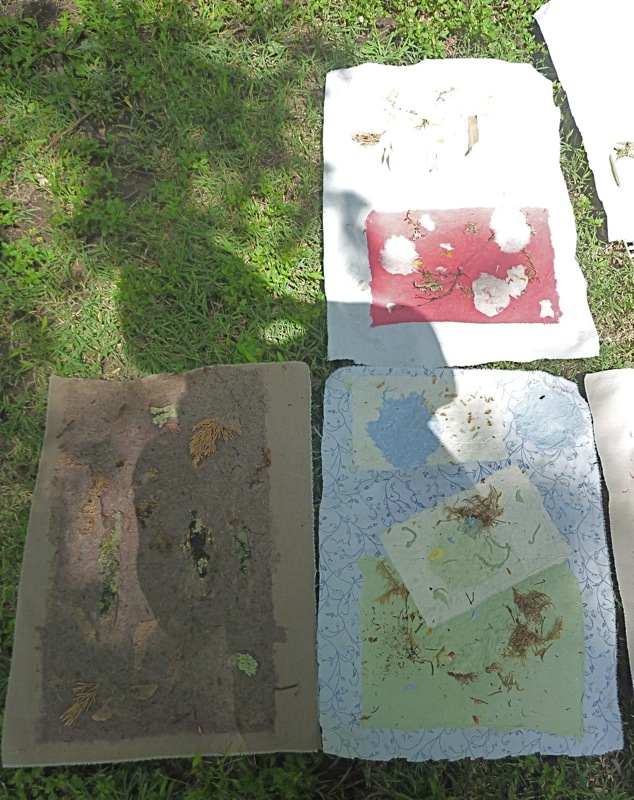
I added pieces of bark, dry bamboo leaves, flower petals, twigs, etc. into my paper, experimenting with attaching them but not completely covering them in additional pulp layers. As the day went on I got much more daring in my additions, applying significant pieces of bark and tall grasses to the paper. As is so often the case with workshops, just as I got to feeling like things were really cooking, it was time to clean up.
Right before we came home I quickly rounded up the bits of stray pulp we'd pulled off the deckle frames and I rolled them into colorful beads. Paper jewelry! Yet another use for this versatile medium!
The trickiest part of the day was fitting all of our creations into my car, keeping them flat and not stacking them for the drive home. Now our dining room table and chairs, and my studio floor are covered with them now until they dry enough to lift off the cloths and store. The main thing paper and ceramic artists need? Lots of space!
I'll look forward to a chance to participate in another papermaking workshop. There is so much more to explore!
| Judy Tobie, workshop teacher |
| Drying paper (l.) & pulp still inside deckle (r.) on cloths |
| Some workshop participants blotting their paper. |
Our afternoon lesson was on making a simple shaped bowl form, much the same way you'd make a draped form with clay.
| Shaping a bowl from paper pulp. |
Once the drying paper sheet is lying on the felt it can be moved onto a larger flat screen or just onto the grass to dry in the sun.
| New paper sheets drying on cloths. |
I added pieces of bark, dry bamboo leaves, flower petals, twigs, etc. into my paper, experimenting with attaching them but not completely covering them in additional pulp layers. As the day went on I got much more daring in my additions, applying significant pieces of bark and tall grasses to the paper. As is so often the case with workshops, just as I got to feeling like things were really cooking, it was time to clean up.
| My papers on felts, drying on the lawn. |
| Papers finishing drying on a screen on the floor in my studio. |
| Paper beads drying out. |
I'll look forward to a chance to participate in another papermaking workshop. There is so much more to explore!
Saturday, July 9, 2011
The Seat of Creativity
| Chaos Disc, ©Joy Kreves |
I have a new art studio chair, an ergoErgo "dynamic seating" chair. There is a philosophy for everything these days, even a philosophy of sitting.
| ergoErgo "dynamic seating" chair |
What is the ideal chair from which to read, write, or create? Well many people say our bodies need to move much more, and sit inactively much less. I spend most of the time in my studio standing, but occasionally when I'm working at something on a table I can sit down.
| Orbit Disc, ©Joy Kreves |
| Ocean Disc, ©Joy Kreves |
| Old, dangerous studio chair. |
Aside from being less likely to seriously maim myself on my new ergoErgo chair, it takes up much less room than the other, and may even have real health benefits! The chair's designer, Alan Heller, got the inspiration for it from watching his wife sit on one of those giant exercise balls. It gives just a bit, the way those do, but has the advantages of taking up much less space and not rolling around the room though still allowing the sitter to shift. Sitting on it is actually fun. I've sat on the chair a few days this week already, while working on paintings, and haven't worried about it tripping me once! It's lightweight enough to carry about, but seems substantial enough to last a long time. It's even weatherproof. Although it comes in an exciting, bright orange, I decided the black would be less distracting in my studio.
I love to read, but this is just another sedentary activity. I just finished reading the exciting 681 page biography of Madame Chiang Kai-Shek, THE LAST EMPRESS, by Hannah Pakula. This was accomplished in the smorgasboard of seating that our recently emptied nest provides. Some of the chapters were devoured while on the bed, the sofa, the other sofa, and...okay, I have a confession. I have one of those really decadent massage chairs that everybody wants to try out at the Brookstone stores in the mall but which are always full of children who won't get up. I finished the book in that chair last night. The massage chair was a big present to mark a big birthday, and I've enjoyed it for a number of years. Because it is in a handy location near my computer, I end up sitting there more than I'd like, though. Most of my blog posts have been written from it. The odd thing about that chair is that when you're not getting massaged in it, you are locked into the most rigid position of all! Partly because it is really sized for a larger person, (my feet don't reach the ground on it) it allows for less freedom of movement than any other chair in the house. This is why I am planning to lobby for another ergoErgo to be kept near that massage chair. That way the massage chair can be mainly for massaging, and I can have more quality "dynamic sitting" time!
Now for my most important question: Will the ergoErgo chair help me channel my creative muse? Is "dynamic sitting" related to "inspired sitting"? I'll bet it is, but if not, at least this studio chair isn't out to kill me!
Friday, June 17, 2011
Popcorn in My Soul
Last night's rain hitting the skylight sounded exactly like corn popping. Odd, the connections you think of when something is in the forefront of your mind. Popcorn was on my mind, because I'd just been to Metuchen, NJ, to hear artist Sandy Skoglund talk about her work, and she'd shown an image of one of her room sized installations that was a landscape entirely covered with popcorn. Searching for it again just now, I find that amazingly, the work is actually titled, "Raining Popcorn"!
Although I've been an admirer of Skoglund's art since I first came across images of it in NYC in the late 1970's, I was unfamiliar with this piece. I immediately connected with it in a way only a Midwesterner could. Indeed, she said her inspiration for it was the landscape surrounding the University of Iowa where she attended graduate school. Skoglund's "Raining Popcorn" reminded me of a Carl Sandburg story my father used to read me, THE HUCKABUCK FAMILY: AND HOW THEY RAISED POPCORN IN NEBRASKA AND QUIT AND CAME BACK. In this story the popcorn the Huckabucks raised catches fire and explodes, the popping fields eventually filling their barn, and then their house. Their daughter, with the delightful name of Pony Pony, discovers a silver buckle inside of a squash. Somehow this makes the family decide to move. At least that is the way I remember the story.
When I was at Illinois State University in Normal, Illinois, the surrounding landscape consisted of cornfield after cornfield after cornfield. Going for a summer bike ride meant riding on miles of roads lined with cornfields on both sides, taller than myself. Having lived on the East Coast for 30+ years now, that landscape seems a surreal memory.
Harold Gregor, painter and now professor emeritus at Illinois State University, was making a name for himself by painting the absurdly monotonous Illinois cornfields in a romanticized photo-realist style. As I heard the story, apartment dwelling New Yorkers found his depictions of big expanses of sky and horizons a sort of novelty.
My first summer job was detasseling corn. The Illinois farmers would hire high school kids to pull off the "tassles" (seed ends). It was disgustingly hot, hard work, for extremely low pay. I think I may have lasted two days. The corn was scratchy and cut up our arms and hands.
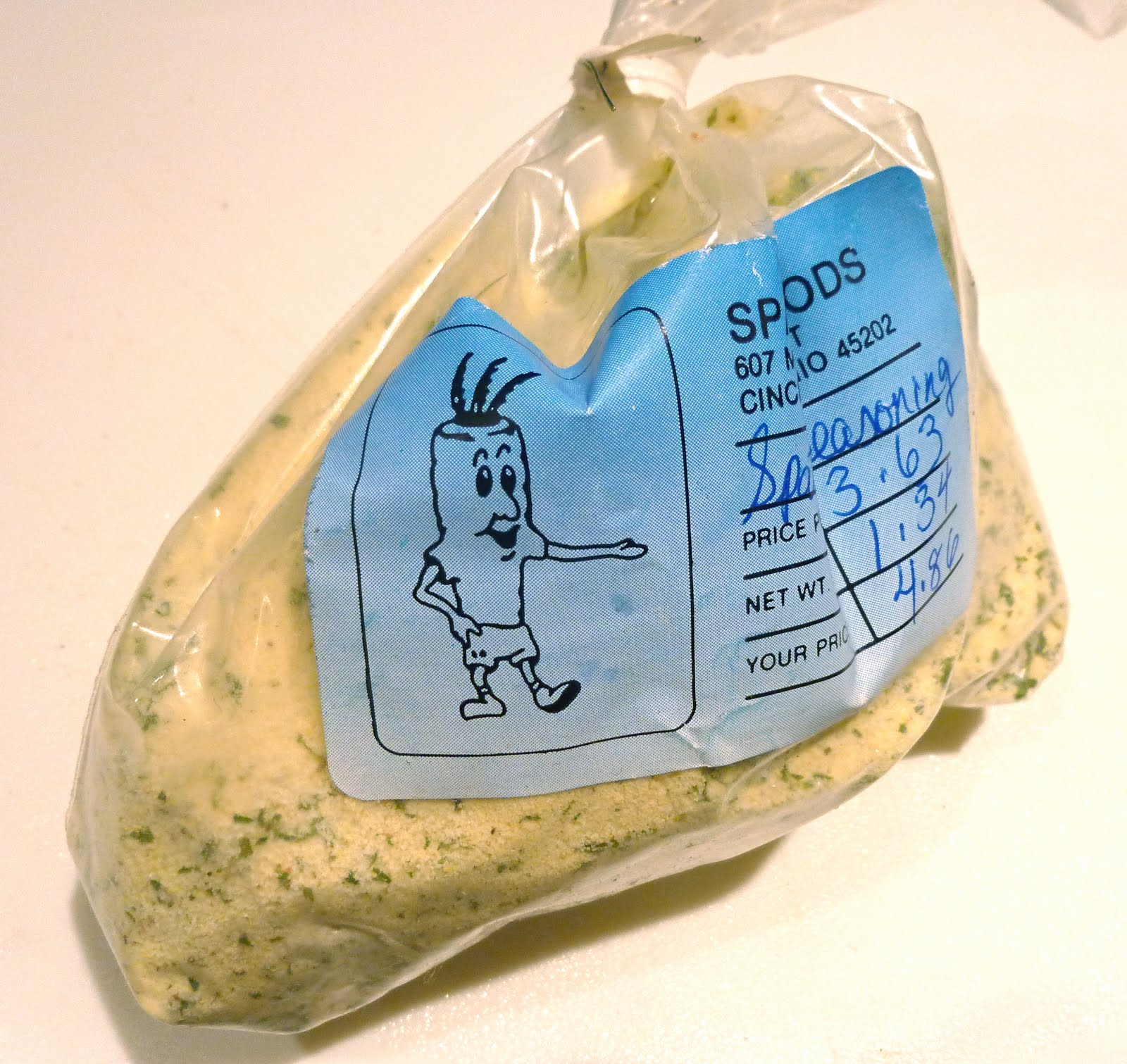
My mother, a native Ohioan, infected her children with a taste for popcorn. A schoolteacher, a minister's wife and the church pianist, Mom was exhausted by the end of the weekend. She wisely decided that Sunday dinner ("supper" as it is known in the Midwest) would consist of soup and popcorn, thus giving her a bit of time off from meal planning. We seasoned our popcorn with Spatz, a very special seasoning that she ordered in bulk from an Ohio health food store. I've never liked popcorn seasoned as well any other way. Some months before she died, in 2000, Mom actually gave each of us kids several pounds of Spatz seasoning as a present. It was as good as gold. I kept mine in the freezer for years, unable to bring myself to use it up. Only recently did I get it out, sprinkle it on popcorn, and enjoy that special flavor.
Even our big, white, fluffy cat, Muff, enjoyed popcorn. We'd throw popped kernels to her from across the room. Superior cat that she was, she'd catch them midair with the quickness many dogs but few cats exhibit towards such sport.
As creatures who depend on planet earth for our sustenance, humans are forever intrinsically tied to the landscape. Though corn has been a recurring theme in the landscape of my life, I have yet to have this influence come out in my artwork. I know, though, that popcorn resides in my soul. Pony Pony Huckabuck is me...Ommm...
Although I've been an admirer of Skoglund's art since I first came across images of it in NYC in the late 1970's, I was unfamiliar with this piece. I immediately connected with it in a way only a Midwesterner could. Indeed, she said her inspiration for it was the landscape surrounding the University of Iowa where she attended graduate school. Skoglund's "Raining Popcorn" reminded me of a Carl Sandburg story my father used to read me, THE HUCKABUCK FAMILY: AND HOW THEY RAISED POPCORN IN NEBRASKA AND QUIT AND CAME BACK. In this story the popcorn the Huckabucks raised catches fire and explodes, the popping fields eventually filling their barn, and then their house. Their daughter, with the delightful name of Pony Pony, discovers a silver buckle inside of a squash. Somehow this makes the family decide to move. At least that is the way I remember the story.
| No toxic microwave packaging for me! |
When I was at Illinois State University in Normal, Illinois, the surrounding landscape consisted of cornfield after cornfield after cornfield. Going for a summer bike ride meant riding on miles of roads lined with cornfields on both sides, taller than myself. Having lived on the East Coast for 30+ years now, that landscape seems a surreal memory.
Harold Gregor, painter and now professor emeritus at Illinois State University, was making a name for himself by painting the absurdly monotonous Illinois cornfields in a romanticized photo-realist style. As I heard the story, apartment dwelling New Yorkers found his depictions of big expanses of sky and horizons a sort of novelty.
My first summer job was detasseling corn. The Illinois farmers would hire high school kids to pull off the "tassles" (seed ends). It was disgustingly hot, hard work, for extremely low pay. I think I may have lasted two days. The corn was scratchy and cut up our arms and hands.
My mother, a native Ohioan, infected her children with a taste for popcorn. A schoolteacher, a minister's wife and the church pianist, Mom was exhausted by the end of the weekend. She wisely decided that Sunday dinner ("supper" as it is known in the Midwest) would consist of soup and popcorn, thus giving her a bit of time off from meal planning. We seasoned our popcorn with Spatz, a very special seasoning that she ordered in bulk from an Ohio health food store. I've never liked popcorn seasoned as well any other way. Some months before she died, in 2000, Mom actually gave each of us kids several pounds of Spatz seasoning as a present. It was as good as gold. I kept mine in the freezer for years, unable to bring myself to use it up. Only recently did I get it out, sprinkle it on popcorn, and enjoy that special flavor.
Even our big, white, fluffy cat, Muff, enjoyed popcorn. We'd throw popped kernels to her from across the room. Superior cat that she was, she'd catch them midair with the quickness many dogs but few cats exhibit towards such sport.
As creatures who depend on planet earth for our sustenance, humans are forever intrinsically tied to the landscape. Though corn has been a recurring theme in the landscape of my life, I have yet to have this influence come out in my artwork. I know, though, that popcorn resides in my soul. Pony Pony Huckabuck is me...Ommm...
Saturday, June 4, 2011
Celebrating Creativity Through the Eyes of a Bug
| Wrapped Junebug sculpture |
| My unveiled 2011 Junebug sculpture, ©Joy Kreves'11 |
This event is the brainchild of Metuchen's resident ceramist, Linda Vonderschmidt-LaStella. Linda is a creative force in town already with her art studio being a hub for clay students of all ages. I met Linda years ago, when we both belonged to "Cycles", a group of women artists. A couple of years ago we reconnected to have a show she envisioned at Metuchen's Westerhoff Gallery. When Linda asked me if I'd be interested in creating this year's Junebug sculpture to preside over the town for the month, I'd just finished having my solo show at Rider University Art Gallery, and was recalibrating. I'd never made a work of art to stay outside before, and decided to take her up on this challenge.
| JUNE LOVE, ©Joy Kreves 2011 |
| JUNE LOVE, wing detail, ©Joy Kreves'11 |
My “June Love” sculpture on display in Metuchen this month is a natural extension of the lattice idea. I used metal mesh and perforated sheeting for both practical and conceptual reasons. The open “latticed” metal textures make the sculpture lighter and less susceptible to the wind. June bugs eat leaves, often leaving only a lattice of veins. They have abdomens and under-wings that are transparent but for the veins.
I took lots of artistic license with my junebug. Her antennae became more like arm feelers, and I left off her long legs entirely. She is much more glamorous with her swarovsky crystal eyes, than the real thing. Perhaps my June bug will inspire romance; she chewed a heart-shaped hole from her leaf in honor of June brides and true love.
Having grown up on Edward Lear's BOOK OF NONSENSE, I couldn't resist being inspired by my own bug and also came up with several goofy verses on the theme:
There once was a beetle named JUNE
Who would sit on a tree and just croon
As she dined night & day on green leaves she would say,
"Why can't I just sing a nice tune*?"
*June bugs are not known for making a melodious sound.
There was a small town named METUCHEN
Whose residents sang songs in Russian*
They danced through the night to the June bug's delight,
Those wonderful folks of Metuchen.
* I have no idea whether or not Metuchenites actually sing any songs in Russian.
There was a June bug in Metuchen
Who so loved the leaf she was clutchin’,
She nibbled away in a heart-shaped display
That lovely young bug of Metuchen
Who so loved the leaf she was clutchin’,
She nibbled away in a heart-shaped display
That lovely young bug of Metuchen
| June Love detail, ©Joy Kreves'11 |
There is a schedule of events for the ArtFest including presentations by visual artists Sandy Skoglund and Jane Dickson, musicians and filmmakers. For a complete celebration of creativity, come to Metuchen on a Friday evening this month and reflect on what impact the creativity of musicians, filmmakers, chefs, writers, and visual artists has on your own life, and what that's worth. My own answer? Priceless!
Monday, May 16, 2011
Earth Brain
For two weeks I've been working on a new painting. This one has been a real struggle, the kind that causes one to have frequent thoughts like, "should I just scrap the whole thing and start over?" or even, "Why did I think I was an artist, anyway?"
The painting's subject matter is the relationship between the earth and each one of us. As I've worked I've also been turning ideas around in my mind for this post.
Today, as if to spur me on, I spotted a Pileated Woodpecker drilling on a short tree stump in someone's front yard. Once nearly extinct, these striking birds have made a comeback. I'd never seen one before. I whipped out my handy pocket camera and caught a shot:
The painting's subject matter is the relationship between the earth and each one of us. As I've worked I've also been turning ideas around in my mind for this post.
Today, as if to spur me on, I spotted a Pileated Woodpecker drilling on a short tree stump in someone's front yard. Once nearly extinct, these striking birds have made a comeback. I'd never seen one before. I whipped out my handy pocket camera and caught a shot:
| Pileated Woodpecker, ©JoyKreves, 2011 |
-Connection to the earth - That is just what I'm thinking about; the connection of our physical and psychic beings with the earth!
-Ability to find hidden layers - This is exactly the creative process.
-Understands rhythms, cycles and patterns - Clearly, these are necessary artistic skills.
-Warnings - What more important warning could there be than the warning that our earth home is a danger of irreversible damage? This is a theme that runs through my current work.
-Prophecy - Well, I'm honestly not sure yet how this one pertains...
-Associated with thunder - especially pertinent because there have literally been rumbles throughout the week. The storms now are just unnatural in their fury.
-The Earth's drummer - Doesn't every cause NEED a drummer? What better cause to drum for than our earth?
-Pecks away at deception until the truth is revealed - Well, that is just like the process of creating art. One must simply keep pecking away at the painting or sculpture until its own truth is revealed, and sometimes that turns out to be rather different from what you thought you'd end up with. If it's good, it rings true.
I wanted to write about the intimate connectedness of our human be-ing and our natural world. This is what my artwork is about. I am exploring the question, "What does the natural world have to do with ME?" I believe that our brains are actually so infused with the landscape that when that landscape becomes degraded we experience suffering.
| Solastalgia, Waterfall Detail, ©Joy Kreves '10 |
What positive conditions might we humans experience that are directly caused by our deep connection to the earth? How about another of Albrecht's words, "eutierria", or a sense of existing as part of and in harmony with the earth?
| Painting palette for Brain Landscape |
| Painting-in-progress, "Brain Landscape", photo ©Joy Kreves, 2011 |
Did you ever marvel at the way the network of nerves in a human body resembles the branches of a finely-limbed tree? I have. Every level of our physical being seems to have a mirroring aspect in the environment. Our universe is made up of patterns, colors and forms repeated on both microscopic and macroscopic levels. Artists, whose language this is, have long known that beings and their environments have visual sympathies which reflect a deep organic/psychic union.
I've put aside last week's troublesome painting and I have embarked upon a new "Brain Landscape" to more clearly express this idea. The first stage of this work-in-progress is shown in the photo here. My idea begins with the famous photos of our earth as seen from outer space: a luminous, watery blue jewel. I am painting a brain that will have the same luminous water, in rivers and atmosphere.
To artists and naturalists it is no surprise that a being is intrinsically tied to its environment, and yet those people who deny global warming seem to lack a sense of that connection. Those who believe the earth and everything on and in it is here for our human disposal are lacking a fundamental understanding of what it is to be human. Perhaps this is the degradation of humans that Thomas Berry warned about. We cannot drill for gas, pouring toxic chemicals irreversibly into the earth without devastating results to our precious and limited supply of water. And we are that water. Our earth has some land, surrounded by vast oceans. Our bodies contain precious supplies of water throughout. Here is our problem: water is a finite resource. The water that exists is the same water that has existed since the beginning of our earth. This is an awesome fact. If we poison it we will not get any more. In poisoning it we poison ourselves, and our beautiful brain landscapes will be degraded into shriveled, water starved environments incapable of supporting the eutierria that we require as healthy individuals. The rivers and oceans that make our life possible cannot come back from the brink of extinction the way the Pileated Woodpecker has. The earth's landscape can filter out only so many poisons before the toxin load is too great and our ancient water supply is beyond saving. Every human must nourish their beautiful, luminous earth brain. Now.
Subscribe to:
Posts (Atom)