Sunday, November 13, 2011

Overcoming The Autumn of Distractions

"Autumn" is a smooth word that conjures up images of postcard trees and cool days, a season that slides into the cold, snowy calm of winter.   The other name for this season, "Fall", is sometimes more fitting.  In "Fall", the environment is closing down and shedding all non-essentials.  In "Fall" the earth is busy cleaning house. Those leaves that were needed for spring and summer are discarded by wind and fierce rain.  Of course, just like when one begins to clean out a closet, the result is piles and more piles.  I'm not even talking about raked leaf piles; the leaves in my neighborhood are shed in such gargantuan quantities that they pile themselves all over the ground in a thick, messy carpet.  I crackle loudly as I try to slip quietly out to the mailbox without my dog noticing.  I develop an intense craving for clarity and order.
Whirlwind, ©JoyKreves
 Every year September finds me inspired for innumerable house, social, and art projects.  I am reading at least 10 books at a time, daydreaming of happy gatherings, holidays and family celebrations to come.  Then, by early November, I start to feel as if turning all those daydreams into real plans would be a burdensome project I might not be up to.  As the leaves mount and get dragged into the house with every entrance by person or dog, I begin to feel that I've lost my handle on things.  Fall is just too messy, too full.  The flurry of dry leaves is actually a perfect metaphor for my state of mind.  I am convinced that one's mind, one's body, and one's environment are integrally related.
Homesick Brain, ©JoyKreves'11
Scattered around outside are leaves and fallen branches, but scattered in the dining room are notes with possible Thanksgiving recipes to make, birthdays to remember to acknowledge (GOD, I know a lot of Scorpios), and postcards for events to attend.  There are phone numbers for friends to visit post-surgeries, and in the bedroom, piles of out of season clothes to put away.  There are two piles being assembled for donation, and another for holiday gifts.  In my studio are new artworks that haven't found exhibits or homes yet, and pieces of others that need finishing.  There are plants that had to be brought in from the colder nights but which I really  have no room for.  Around November I realize that I have accomplished very little of my plans.  Sometimes, I just feel distracted!
I'm So Distracted Today, ©JoyKreves
Several art shows are the core around which all the other stuff swirls:
 
Currently, I have work at the ArtTimesTwo Gallery, in a four-person exhibit curated by artist Madelaine Shellaby, "Interior Design:  The Brain and Spine in Art", now on view by appointment (http://www.arttimestwo.com) through March 2012.  The gallery is at The Princeton Brain and Spine Care Institute, 731 Alexander Rd, suite 200, Princeton, NJ.

My sculpture "Beautiful Life" is in an exhibit at the picturesque Hunterdon Museum of Art, 7 Lower Center St., Clinton, NJ, through January 7, 2012.
The Beautiful Life, ©JoyKreves'10
In December I will have a number of pieces at The D&R Greenway Land Trust gallery's "Textures & Trails" exhibit curated by Diana Moore, including some of my jewelry.
Essence of Bluejay, ©JoyKreves '08
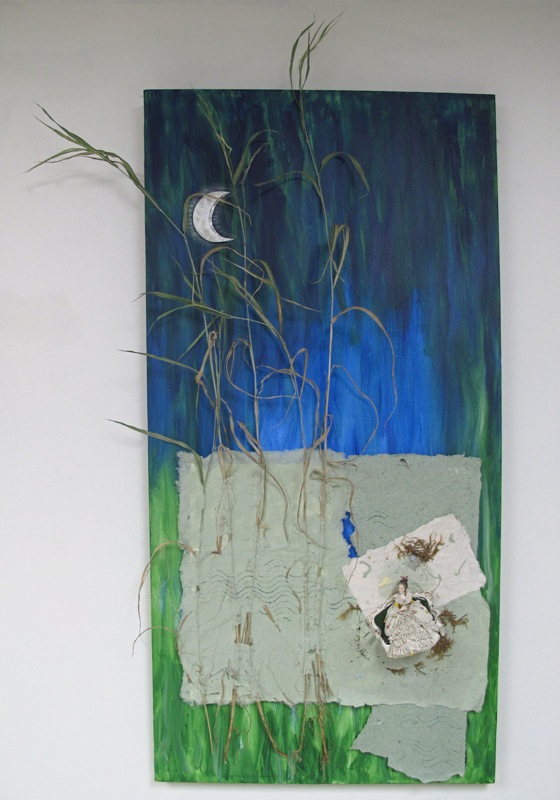
I am especially excited about the opportunity to exhibit "Transported" there, my new mixed media piece there that incorporates some of the paper I made in the workshop with Judy Toby this past summer. 
Transported, ©JoyKreves'11
In JANUARY I'll be delivering three pieces to The George Segal Gallery at Montclair State University, 1 Normal Ave., Montclair, New Jersey, for the juried "Art Connections 8" show.
I'm also excited about completing a new three dimensional waterfall painting, out of acrylic and watercolor on ceramic and wood.  I have too many other ideas cooking to keep track of.

You just cannot stop the onslaught of swirling leaves, and you cannot stop the myriad of exquisite activities and concerts beckoning your attention.  You must not stop your creative flow, either, even as you turn off those outside faucets for the winter.  You've got to keep creating, or at least refining, as the trees poke their newly bare twigs into the uncluttered air of late autumn.  You've got to get a handle on the coming winter.

Today I visited a friend with a great tale of mind/body connectedness.  A poet, she hadn't been able to write for a long time, due to her muse being blocked by pain.  She needed surgery, which she had a couple of days ago.  Well she wrote not one, but five poems while in the hospital!  Uncorked by the diminished pain, her muse flew back into action in spite of the less than inspiring hospital environment.  It was a wonderful thing for me to see her whole being rejoicing in the return of the creative spirit which is her core.  Now mid-November, my muse seems to be just starting to settle into sharper focus, where I hope she'll stay through the winter holidays and breaks, to give me a handle on the coming winter.  I'm reaching for her fingers in the clearing air of late autumn. 

Monday, October 10, 2011

After Art Grows Up and Leaves Home

Yogis and physicists talk about a deep level of reality that underlies everything we know consciously and unconsciously.  Our experiences, thoughts and actions exist only in the top skim of things, like the rings of rippling water after we skip a stone across its surface.  The process of making art sometimes brings artists nearer to that deeper realm.  I hope the process of viewing the art can bring the onlooker there also.

My poem "Lyrics for Electron Playground" is about existing in these levels of reality .  The poem is incorporated into an artwork, "Electron Playground". That artwork is now in Rider University's Permanent Collection, and is hanging in a new building on campus, North Hall.  Last week I went to see it there.  It is beautifully installed in a plexiglass wallbox at the end of a hallway: 

ELECTRON PLAYGROUND, ©JoyKREVES, 2010
LYRICS FOR
ELECTRON PLAYGROUND

Heart beats
Dog barks
Turtle dies

Tides pull
Leaves turn
Lightnings spark

Dreams are born where
electrons dance and
baby is the oldest brain alive

Time is now here
Time is nowhere
Time is now here

Heat rises
Cat awakens
Baby cries

Moons rise

Nudes descend

Poppies bud

Dreams thrive where
electrons bounce and
youth are the prophets of night

Time is nowhere
Time is now here
Time is nowhere

Hearts stop
Sirens wail
Oceans expire

Forests grieve
Rains drown
Air sours

Dreams collide where
electrons play and
sages gaze beneath the finish line

Time is now here
Time is nowhere
Time is now here

                      -Joy Kreves ‘10

I've been prejudiced in believing that artists and people involved with the humanities have a headstart on leading meaningful lives.  Apple's Steve Jobs' life was proof that, in fact, it is the ability to think creatively in any field that enables one to leave behind a trail of significant achievements. Being able to think creatively is the key, because it gives one a better chance of finding an access to the deepest plane of reality, that plane beyond conscious reach.  I am convinced that this is where real meaning resides and those who taste it are deeply enriched by the experience.

As I was looking at my ELECTRON PLAYGROUND piece in the hallway, a friend who teaches philosophy at Rider came by.  He was excited because his office is in this new building, just down the hall from my piece, and he wanted to show me that he had hung my DOUBLE-HEADED SPIRAL over his office desk.  He purchased that piece and another from the series several years ago, and they both hung in his home for awhile.  He then proceeded to tell me a story in which he was
DOUBLE-HEADED SPIRAL, ©JoyKREVES, private collection
the classic absent-minded professor.  A prankster friend had stayed at his house and re-hung every piece of his artwork upside down.  My professor friend never noticed until he brought DOUBLE-HEADED SPIRAL to the college, that the friend had also turned my spiral upside down!  Even then, it was the gallery director who helped him hang it, who noticed my upside down signature.  It's in a metal shadowbox frame, and the friend had actually unscrewed the hanging wire to reverse the piece.  My friend, lost in the world inside of his head, never noticed that DOUBLE-HEADED SPIRAL was now DOUBLE-FOOTED SPIRAL!  I console myself by remembering that any good artwork can "work" in any direction.  Or so they claim. Actually, the space depicted in the spirals is not tied to a horizon; it is a broader more universal "deep space" that includes notions of time and timelessness, as does ELECTRON PLAYGROUND, and I admit that I have also lost track of what was right-side-up for several of the pieces at certain points in time. 

Yesterday I attended the reception for the ABSTRACT SHOW at The Coryell Gallery in Lambertville where several of my friends are showing.  Once again I came away being very confused as to what really constitutes "abstract" art.  For me, there has never been a meaningful division between abstraction and realism.  It seems a work is considered "abstract" as soon as it departs from the depiction of "things" and ventures into a depiction of "space", but as we learn that space is jammed full and not empty at all, and as we are able to see this stuff quite tangibly with increasingly high powered technology, the term "abstraction" loses meaning.  Hopefully, through technology or meditation, many of us can dive down to that deep plane of omniscient awareness that seems to be the basis that unites everything as well as everynonthing, every potential thing.  In a utopian scenario of the future most of us would get in deeper touch with our creative selves and thus leave behind a truly significant trail in our wake.  Pondering a work of art, whether upside or down, can sometimes open the door to a world so much larger than ourselves. Time may not exist in the most abstract reality, but in our manifested everyday reality, the time is now.  Art grows up and moves away, but once comprehended, it's effect is never erased. Whether we turn it upside down or sideways, whether it is "abstract" or "realistic", it aids us in leading meaningful lives.  Awesome.

Friday, September 23, 2011

Can Dogs Appreciate Art?

Relatives of mine have had dogs who "sang" along with them, or their piano playing.  The dogs may have just had the instinct to join into a stand-in for a  canine chorus. My brother's German shepherd, however, would get started with help, but went onto more solo singing than I'd expect from pure instinctual behavior. 

Last night my dog reacted to a photograph, making me wonder if dogs can make sense of two dimensional images. If dogs can make sense of pictures, it follows that they might be able to appreciate art in some way.  Perhaps they are even capable of having an aesthetic experience. 

I had sat down on the old white sofa to look at a magazine.  Because it's the only piece of furniture my dog is allowed to come up on, he happily made his arthritic effort to join me there.  I leafed through page after page of creative advertisements as he relaxed beside me, but when I came to the double spread for Bulgari in which a bare model embraces  a fragrance bottle while cuddling up to a lion, he lifted his head and strained his nose towards the magazine, sniffing intently.  My dog continued his investigation until he satisfied himself that there was no living creature there wearing that fur.  Although the ad shows a fragrance bottle, there is no sample of it in the page, so he was not reacting to a smell.  He must have reacted to the image of fur or perhaps the lion's features.  I tested the theory by continuing to turn pages of photographs and watching him ignore me.  I stuck some other pages under his nose, which he simply ignored, but when I stuck the spread with the lion in his face again he sniffed it again, for a shorter time and with less interest than the first time before relaxing again with a sigh, as if saying,  "Oh yeah, that's that same nothing I checked out before." 
In an article in Cerebrum, from the Dana Foundation, "your gateway to information about the brain and brain research", authors Gisela Kaplan, Ph.D. and Lesley J. Rogers, D. Phil., D.Sc. say,
"Creation and appreciation of art are aspects of consciousness that we have tradition-ally viewed as purely human activities, ones that express our highest cognitive abilities. If animals share at least some aspects of this ability, we will have to look upon them with more respect and perhaps change the ways we treat them."
The authors go on to say that "some researchers have dared to suggest that animals may play because they find it pleasurable to do so. Doing something for pleasure, rather than for survival, is part of how we define the act of creating art."  They warn against forming any conclusions too soon, but I'll peak around that corner to see what may lie there.  Perhaps my dog has not only the ability to appreciate art, but the ability to create it! 

I've been amazed to watch my dog play creative games.  He has trained me to throw treats out the window.  Usually he runs right to it, settles down on a plush patch of grass, and begins to devour it.  Several times, though, although I'd thrown the treat with pretty good aim, landing it near him and certainly within his sight and smell range, I've seen him pretend not to see it.  This dog who has smelled a stale oreo cookie 15 ft. away, pretended that he just could not see or smell that fresh treat right under his nose!   After a few minutes of exhaustive "searching", he finally "discovered" it, joyfully tossing it in the air.  This was pure pretending, pure playing.  To create art it is necessary to engage in lots of pretending in order to create illusions of form and space.  Having the ability to pretend implies an ability to appreciate creative pretending, does it not?

The magazine lion incident reminded me of a Halloween some years ago.  When my daughter was a toddler (before we had our dog) she had a lion costume.  We later gave it to a friend who had two adorable little girls, and one Halloween they came trick-or-treating to our house, one wearing that costume and the other in a similar one.  Our dog did not know what to make of them.  He kept his distance and looked quizzicaly up to me, then barked a very questioning alert and looked back at me with the most confused expression ever.  The funny and adorable scene left such an impression on me that I spent several hours searching for the photograph before realizing that the image was only committed to my memory.

More funny incidents occur around Christmastime, when we walk our dog around the neighborhood.  Several people display sculptures of reindeer in their yards.  Our dog has slowed down to suspiciously eye those white cutout wooden deer, and he has actually charged at the willow branch ones.  This is slightly embarrassing to both of us.  You would hope your dog could tell the difference between reality and decoration!

I have not practiced showing my dog two-dimensional images so he could perhaps appreciate portraiture.  If he could "read" a photograph of fur or a lion's face to recognize it as resembling a real animal; if he could "read" a sculpture of a deer as the actual animal, perhaps he would enjoy a little portrait gallery at his own eye level.  Hmmm....

Wednesday, August 24, 2011

Red Horses & Blue Dough


TAKING FLIGHT SCULPTURE Detail ©JKreves
 It's a good thing I'm not a '50's American housewife, because I detest ironing more than any other household chore.  Lucky for me, we rarely can't not get away with un-ironed clothing in this day and age.  I'd rather clean a bathroom than iron,  which makes my activity today quite ironic:
TAKING FLIGHT SCULPTURE from WETLANDS  ©Joy Kreves'10


I spent the afternooon in the garage ironing bamboo leaves.  I made a mini ironing board by cushioning a strip of cardboard with layers of cloth and used dryer sheets.  This was needed because I am getting a sculpture ready to show again (Verde Gallery's "Spaces" Exhibition) after it spent several months in storage.  When I took it out yesterday, I thought perhaps the myriad of dry bamboo leaves had curled a bit more than when the sculpture was initially exhibited.  I wasn't sure if I could even iron them permanently flat, but I made the mini ironing board, took the iron into the garage and went to town on the sculpture.    As I ironed my bamboo leaves, it occurred to me that this is not a normal thing to do. Your typical American does not spend afternoons ironing bamboo leaves. 

Baking blue dough.
Coming upstairs for a break, I came upon my daughter and her friend in the kitchen, staring at a big blue blob in the toaster oven.  My daughter explained that they had put food coloring into homemade dough, and were baking it.  This is when I realized that my family is not exactly "normal", either.  Things in our house are just a bit "off" from how other people live and spend their time.  When I raised my eyebrows, my daughter defended her creation by saying, "Well, you drew a red horse, so I can make blue dough!"

RED HORSE ©Joy Kreves
 
She is entirely correct, of course.  She grew up hearing my story about the red horse:

I was a child sitting on the floor, drawing alongside my older sister.  I was finding great pleasure in applying the RED crayon very heavily to create a solidly red horse.  My sister objected to my color choice, saying, "You can't make a red horse; horses aren't red!"  In that moment I suddenly understood that art was this great freedom in which you could depart from reality in whatever manner you could think of.  Of course I could make a red horse; I already had.

Art is what lets me and my daughter depart from the real world to dive into the rich world of the imagination.  Creating art can give one a feeling of great power.  Art can lead one to draw red horses, and bake blue dough.  Art is freedom pure and simple. Oddly it can also bring one full circle into doing what one most dislikes...but this time I'm ironing ironically.

Thursday, August 18, 2011

Papermaking Perfection

Tomorrow's rain date won't be needed for Judy Tobie's papermaking workshop. Today was as perfect a day as you could want for such a venture:  sunshine, and not too sticky hot.  My daughter and  I showed up with several other people to literally dip our hands into this intriguing medium.
Judy Tobie, workshop teacher
Judy had set up long tables on the lawn with blotter cloths on them for each workshop participant to work at, and other tables over a gravel area.  On them were big plastic tubs, each filled with a pigmented paper pulp dispersed in water.
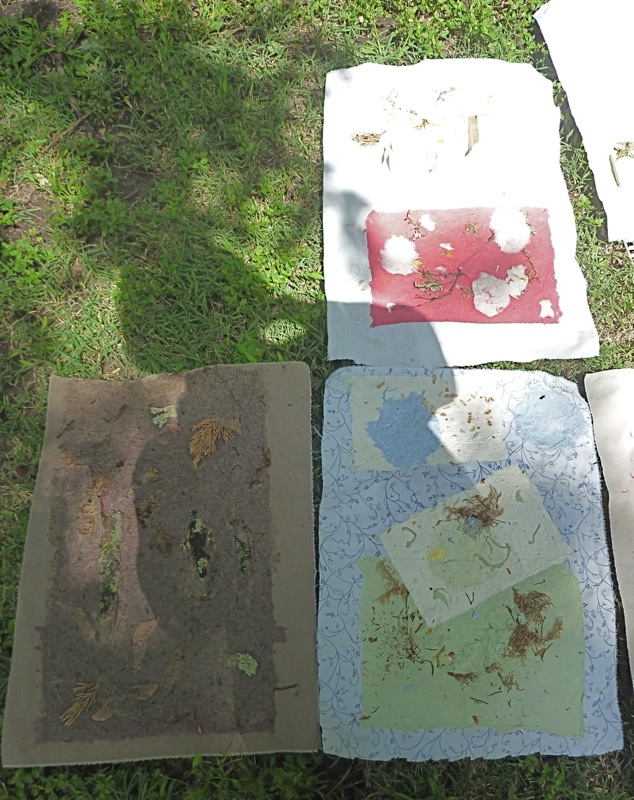
Drying paper (l.) & pulp still inside deckle (r.) on cloths
 She showed us how to hold the deckle frame and framed screen together to dip in the pulp.  Then we drained some of the water off, carried it to our table, lifted the deckle off and applied the screen to a piece of sheet (a "felt") layered over the chamois.  After lifting the screen and blotting the paper with a sponge, the paper was ready to either dry or to apply interesting items to and sandwich them under more paper layers.
 
Some workshop participants blotting their paper.


As we got the hang of this it was hard to stop for the break when Judy brought out a beautiful and delicious summer lunch to enjoy beneath the shade of a tall bamboo stand.
Our afternoon lesson was on making a simple shaped bowl form, much the same way you'd make a draped form with clay.
Shaping a bowl from paper pulp.
Since I've done work with clay for years, I was constantly comparing that medium to this as I worked.  Both are sufficiently messy that a special type of indoor studio space is warranted if one can't work outside.  Both (especially wheelthrowing clay) use a significant amount of water during the process. Both give you options for embedding textures.  Although the papermaking set up seems simpler, a serious artist might feel the need for some costly tools like a beater and a drying machine, and of course the ceramic artist needs at least a kiln to fire their finished creations.

Once the drying paper sheet is lying on the felt it can be moved onto a larger flat screen  or just onto the grass to dry in the sun.
New paper sheets drying on cloths.
My daughter worked on a circle theme with the intention of making them pages of a book:


I added pieces of bark, dry bamboo leaves, flower petals, twigs, etc. into my paper, experimenting with attaching them but not completely covering them in additional pulp layers.  As the day went on I got much more daring in my additions, applying significant pieces of bark and tall grasses to the paper. As is so often the case with workshops, just as I got to feeling like things were really cooking, it was time to clean up.

My papers on felts, drying on the lawn.
Papers finishing drying on a screen on the floor in my studio.
 Right before we came home I quickly rounded up the bits of stray pulp we'd pulled off the deckle frames and I rolled them into colorful beads.  Paper jewelry! Yet another use for this versatile medium!
Paper beads drying out.
 The trickiest part of the day was fitting all of our creations into my car, keeping them flat and not stacking them for the drive home.  Now our dining room table and chairs, and my studio floor are covered with them now until they dry enough to lift off the cloths and store.  The main thing paper and ceramic artists need?  Lots of space!
I'll look forward to a chance to participate in another papermaking workshop.  There is so much more to explore!


Saturday, July 9, 2011

The Seat of Creativity

Chaos Disc, ©Joy Kreves

I have a new art studio chair, an ergoErgo "dynamic seating" chair.  There is a philosophy for everything these days, even a philosophy of sitting.
ergoErgo "dynamic seating" chair

What is the ideal chair from which to read, write, or create?  Well many people say our bodies need to move much more, and sit inactively much less. I spend most of the time in my studio standing, but occasionally when I'm working at something on a table I can sit down.
Orbit Disc, ©Joy Kreves

Ocean Disc, ©Joy Kreves


A few years ago, when I was working on a series of very detailed line drawings at a table,  I found myself developing back problems and bought one of those chairs with two seats, the lower one to put some of your weight on your knees and get your back into a better position.
Old, dangerous studio chair.
Unfortunately, I nearly fell flat on my face almost every time I used that chair, and I'm a careful person!  The phone would ring, I'd step forward as I got up to answer, catch my foot on the wheel that is unwisely placed just ahead of where your foot is, and really it is a miracle that I never actually did have that accident. I came close, so many times.  I put it out on the curb yesterday with a note taped to the seat, "FREE, but BEWARE! The wheels easily trip you up!"  Someone took it within 1/2 hour.  My conscience is clear, though; I gave fair warning. 

Aside from being less likely to seriously maim myself on my new ergoErgo chair, it takes up much less room than the other, and may even have real health benefits!  The chair's designer, Alan Heller, got the inspiration for it from watching his wife sit on one of those giant exercise balls.  It gives just a bit, the way those do, but has the advantages of taking up much less space and not rolling around the room though still allowing the sitter to shift.  Sitting on it is actually fun.  I've sat on the chair a few days this week already, while working on paintings, and haven't worried about it tripping me once!  It's lightweight enough to carry about, but seems substantial enough to last a long time.  It's even weatherproof.  Although it comes in an exciting, bright orange, I decided the black would be less distracting in my studio.

I love to read, but this is just another sedentary activity.  I just finished reading the exciting 681 page biography of Madame Chiang Kai-Shek, THE LAST EMPRESS, by Hannah Pakula. This was accomplished in the smorgasboard of seating that our recently emptied nest provides.  Some of the chapters were devoured while on the bed, the sofa, the other sofa, and...okay, I have a confession.  I have one of those really decadent massage chairs that everybody wants to try out at the Brookstone stores in the mall but which are always full of children who won't get up.  I finished the book in that chair last night.  The massage chair was a big present to mark a big birthday, and I've enjoyed it for a number of years.  Because it is in a handy location near my computer, I end up sitting there more than I'd like, though.  Most of my blog posts have been written from it.  The odd thing about that chair is that when you're not getting massaged in it, you are locked into the most rigid position of all!  Partly because it is really sized for a larger person, (my feet don't reach the ground on it) it allows for less freedom of movement than any other chair in the house. This is why I am planning to lobby for another ergoErgo to be kept near that massage chair. That way the massage chair can be mainly for massaging, and I can have more quality "dynamic sitting" time! 

Now for my most important question:  Will the ergoErgo chair help me channel my creative muse?  Is "dynamic sitting" related to "inspired sitting"?  I'll bet it is, but if not, at least this studio chair isn't out to kill me!

Friday, June 17, 2011

Popcorn in My Soul

Last night's rain hitting the skylight sounded exactly like corn popping.  Odd, the connections  you think of when something is in the forefront of your mind.  Popcorn was on my mind, because I'd just been to Metuchen, NJ, to hear artist Sandy Skoglund talk about her work, and she'd shown an image of one of her room sized installations that was a landscape entirely covered with popcorn.  Searching for it again just now, I find that amazingly, the work is actually titled, "Raining Popcorn"!

Although I've been an admirer of Skoglund's art since I first came across images of it in NYC in the late 1970's, I was unfamiliar with this piece.  I immediately connected with it in a way only a Midwesterner could.  Indeed, she said her inspiration for it was the landscape surrounding the University of Iowa where she attended graduate school.  Skoglund's "Raining Popcorn" reminded me of a Carl Sandburg story my father used to read me, THE HUCKABUCK FAMILY:  AND HOW THEY RAISED POPCORN IN NEBRASKA AND QUIT AND CAME BACK.  In this story the popcorn the Huckabucks raised catches fire and explodes, the popping fields eventually filling their barn, and then their house. Their daughter, with the delightful name of Pony Pony, discovers a silver buckle inside of a squash.  Somehow this makes the family decide to move.  At least that is the way I remember the story. 
No toxic microwave packaging for me!

When I was at Illinois State University in Normal, Illinois, the surrounding landscape consisted of cornfield after cornfield after cornfield.  Going for a summer bike ride meant riding on miles of roads lined with cornfields on both sides, taller than myself. Having lived on the East Coast for 30+ years now, that landscape seems a surreal memory.

Harold Gregor, painter and now professor emeritus at Illinois State University, was making a name for himself by painting the absurdly monotonous Illinois cornfields in a romanticized photo-realist style.  As I heard the story, apartment dwelling New Yorkers found his depictions of big expanses of sky and horizons a sort of novelty.

My first summer job was detasseling corn.  The Illinois farmers would hire high school kids to pull off the "tassles" (seed ends).  It was disgustingly hot, hard work, for extremely low pay.  I think I may have lasted two days.  The corn was scratchy and cut up our arms and hands.

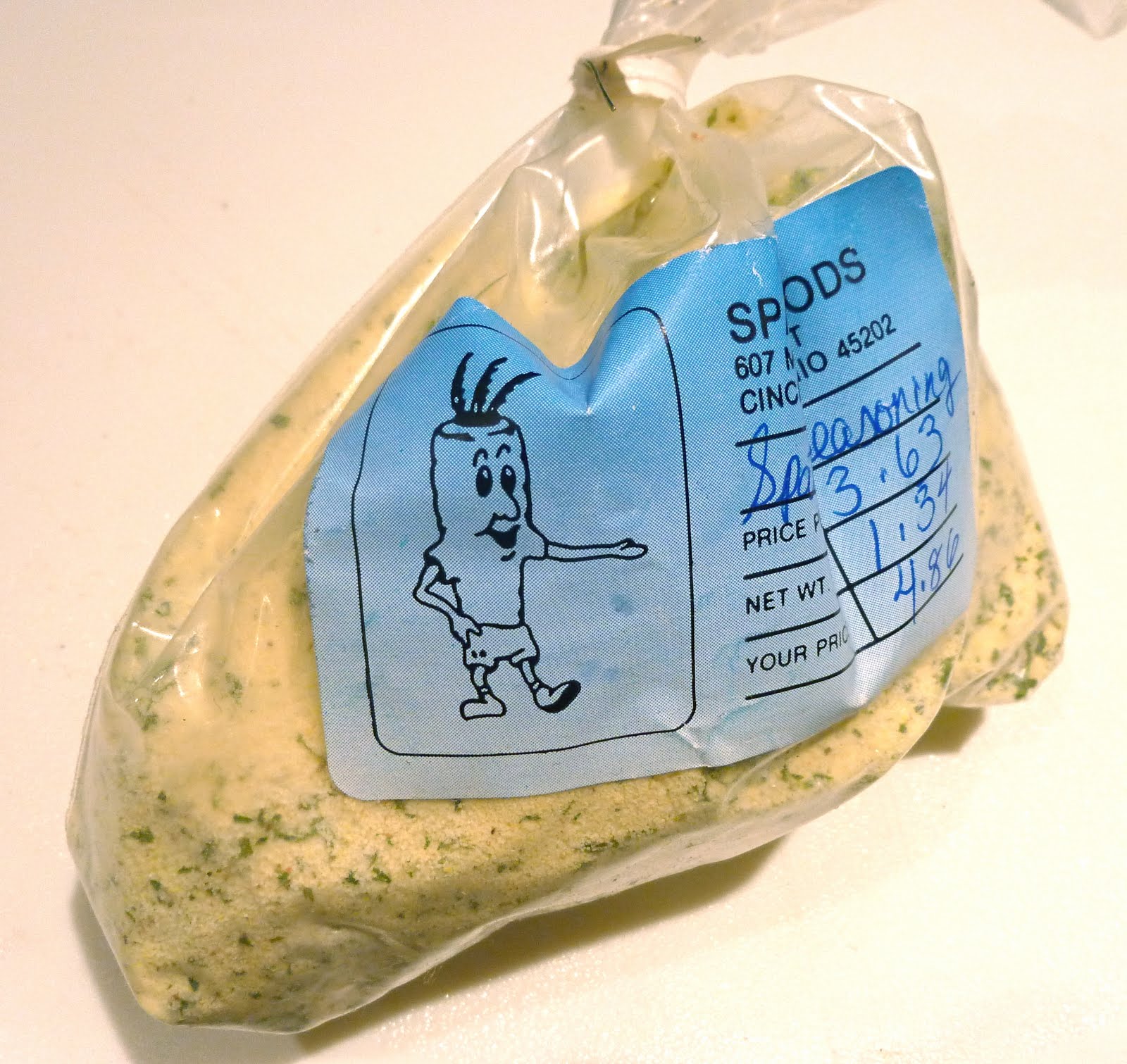
My mother, a native Ohioan, infected her children with a taste for popcorn.  A schoolteacher, a minister's wife and the church pianist, Mom was exhausted by the end of the weekend.  She wisely decided that Sunday dinner ("supper" as it is known in the Midwest) would consist of soup and popcorn, thus giving her a bit of time off from meal planning.  We seasoned our popcorn with Spatz, a very special seasoning that she ordered in bulk from an Ohio health food store.  I've never liked popcorn seasoned as well any other way.  Some months before she died, in 2000, Mom actually gave each of us kids several pounds of Spatz seasoning as a present.  It was as good as gold.  I kept mine in the freezer for years, unable to bring myself to use it up.  Only recently did I get it out, sprinkle it on popcorn, and enjoy that special flavor.

Even our big, white, fluffy cat, Muff, enjoyed popcorn.  We'd throw popped kernels to her from across the room.  Superior cat that she was, she'd catch them midair with the quickness many dogs but few cats exhibit towards such sport. 

As creatures who depend on planet earth for our sustenance, humans are forever intrinsically tied to the landscape.  Though corn has been a recurring theme in the landscape of my life, I have yet to have this influence come out in my artwork.  I know, though, that popcorn resides in my soul.  Pony Pony Huckabuck is me...Ommm...

Followers